How Sales Force Automation is Reshaping Manufacturer Field Teams in 2025

For decades, manufacturers relied on manual sales processes—order slips, Excel trackers, phone calls, and endless follow-ups through WhatsApp or email. While these methods worked in the past, they no longer match the pace of today’s digital-first manufacturing ecosystem.
In 2025, businesses can no longer afford inefficiencies in their sales cycle. Dealers expect faster response times, real-time visibility, and seamless coordination. Field sales inefficiencies aren’t just operational challenges—they directly translate into lost orders, dealer dissatisfaction, and missed growth opportunities.
Sales Force Automation (SFA), It’s not just a buzzword anymore—it’s a growth strategy. By automating every aspect of field sales operations, SFA allows manufacturers to scale faster, reduce errors, and empower sales reps to focus on selling instead of reporting. In this blog, we’ll dive deep into how SFA is reshaping manufacturer field teams in 2025, explore its real-world benefits, future trends, and why adopting a robust platform like EzeOne’s SFA Suite can help your business gain full control and visibility over sales.
What is Sales Force Automation (SFA)?
Sales Force Automation (SFA) is software designed to automate, streamline, and track every aspect of the sales process, particularly for field sales teams. Rather than depending on manual methods, SFA gives manufacturers the tools to log, track, and measure sales operations in real time.
Some of the most common functions include:
- Logging dealer visits digitally.
- Taking orders instantly through mobile apps.
- Monitoring sales rep routes with geo-tagging.
- Sharing updated product catalogs and schemes with dealers.
- Generating dashboards and reports instantly.
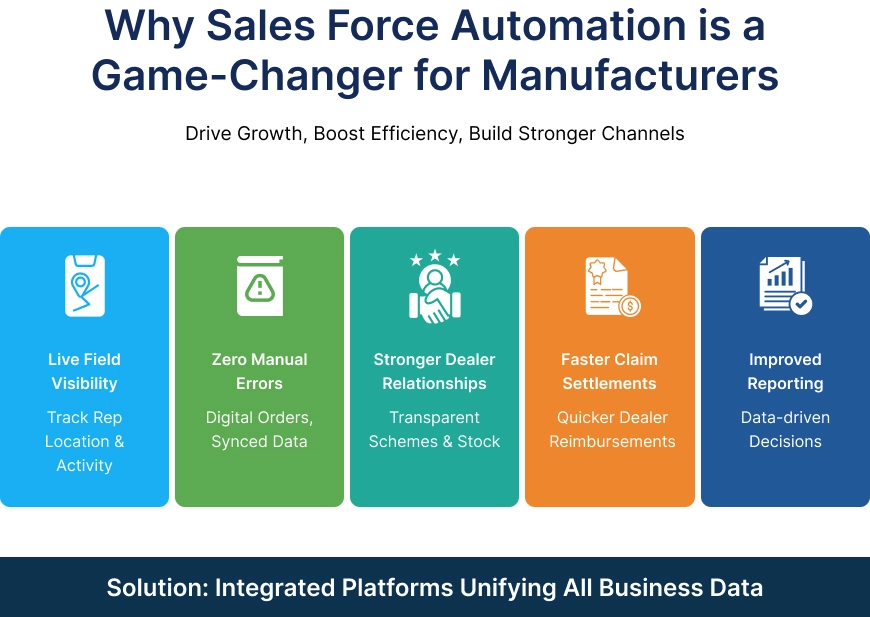
Why Sales Force Automation is a Game-Changer for Manufacturers
SFA has completely changed the way manufacturers manage sales teams in India and globally. By using digital tools, businesses are not only reducing inefficiencies but also empowering their sales reps and dealers with transparency.
Here are some key reasons why manufacturers are adopting SFA at scale:
- Live Field Visibility: Managers know exactly where reps are and what activities they’re completing.
- Zero Manual Errors: Orders are logged digitally, synced with pricing and inventory systems.
- Stronger Dealer Relationships: Transparency in schemes, stock, and communication improves dealer satisfaction.
- Faster Claim & Scheme Settlements: Dealers receive quicker reimbursements for schemes.
- Improved Reporting & Analytics: Businesses rely on data, not guesswork.
Features to Look for in a Good SFA Platform
Not all SFA software is created equal. Manufacturers must choose solutions designed for their industry’s needs, especially in markets like India where dealer and distributor networks are large and diverse. The right features improve adoption and ensure ROI.
Look for the following:
- GPS Tracking & Visit Logs: Ensure reps are accountable.
- Order Management: Simplify order booking.
- Product Catalog & Inventory Integration: Keep dealers updated.
- Beat Plan Scheduling: Manage daily coverage efficiently.
- Digital Payments: Ensure faster collection cycles.
- Analytics Dashboard: Real-time sales monitoring.
- Offline Syncing: Useful in rural regions.
Benefits for Dealers & Distributors
Dealers and distributors are key pillars of a manufacturer’s growth. When they face delays, confusion, or unclear scheme policies, they naturally lean toward competitors. SFA brings much-needed clarity, transparency, and speed to dealer interactions.
Some direct benefits for dealers include:
- Faster order placement with instant confirmations.
- Real-time stock visibility and updated schemes.
- Transparent claim processing.
- Digital invoices and payment tracking.
- Loyalty and rewards program integration.
Future of Sales Force Automation in 2025 & Beyond
The future of SFA is rapidly evolving in India and globally. Manufacturers who adopt these advanced tools early will have an edge. Beyond the basics of order booking and tracking, SFA is moving into predictive and AI-driven intelligence.
Emerging trends include:
- AI-powered insights for sales forecasts.
- Voice-enabled reporting.
- IoT integrations for industrial sales.
- Augmented Reality (AR) catalogs for visual product demos.
- Predictive route optimization.
Common Challenges in Adopting SFA (And How to Solve Them)
Like any technology adoption, SFA comes with its own hurdles. Many manufacturers hesitate due to fear of change or integration issues. The key is to address these challenges early and ensure user-friendly rollouts.
The most common challenges and solutions are:
- Resistance to Change: Provide training and show early wins.
- ERP/CRM Integration: Select platforms with modular integration.
- Data Security: Choose cloud platforms with encryption.
- Low Connectivity: Ensure offline syncing for rural regions.
Conclusion: Time to Modernize Your Field Sales in 2025
In 2025, manual reporting and paper-based orders are relics of the past. Manufacturers who delay automation will lose dealer trust and competitiveness. Sales Force Automation is now essential to survive and thrive.
With EzeOne’s Suite, businesses transform sales into a transparent, data-driven, and growth-focused process. With tools like EzeOne Suite, manufacturers now have the power to bring full control, transparency, and agility to their sales force operations.
Want to learn more about how SFA can help your team?
Book a free demo today →