Lead Management System (CRM) for Manufacturers: Capture, Track & Convert Every Lead with Ease

In the modern manufacturing ecosystem, growth is no longer driven only by production capacity or distribution strength. Instead, it is shaped by how efficiently a company can capture, manage, and convert business opportunities — in other words, how well it manages its leads.
Every inquiry received from a dealer, distributor, contractor, retailer, or even an end-customer has the potential to translate into revenue. Yet, in many organizations, these inquiries remain poorly tracked, scattered across spreadsheets, notebooks, WhatsApp chats, or siloed email inboxes. This unstructured approach results in missed opportunities, longer sales cycles, and ultimately, slower growth.
The Importance of Leads in Manufacturing
Manufacturers operate in complex, multilayered markets. Unlike direct-to-consumer companies, they rely on vast networks of intermediaries — including super-stockists, distributors, dealers, retailers, and influencers like painters, plumbers, architects, or carpenters. Each of these stakeholders generates leads in the form of product inquiries, order requests, or project opportunities.
For example:
- A dealer may inquire about bulk orders of cables.
- A distributor may ask about credit limits for FMCG products.
- A painter may request promotional schemes on paints.
- A contractor may want to evaluate sanitaryware options for a large housing project.
Every one of these touchpoints represents a lead — and how the manufacturer responds determines whether the opportunity is won or lost.
Common Pain Points Without Proper Systems
When manufacturers rely on manual methods, several problems emerge:
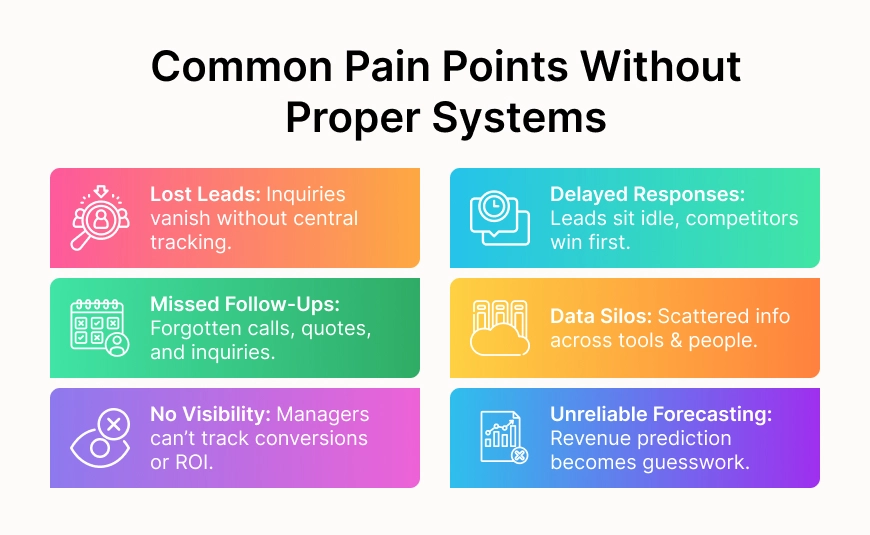
- Lead Leakage – Inquiries received at exhibitions, through websites, or via dealer referrals often go unrecorded. Without a central repository, leads vanish.
- Delayed Responses – Manual assignment means inquiries sit idle before reaching a sales representative, by which time competitors may have closed the deal.
- Poor Follow-Ups – Sales reps juggling dozens of prospects forget to follow up, leading to lost sales.
- Data Silos – Lead data is scattered across different tools and people, making it hard to get a holistic view.
- Lack of Visibility – Managers cannot track how many leads were generated, how many converted, or which campaigns performed best.
- Unreliable Forecasting – Without clear lead tracking, predicting revenue becomes a guessing game.
These pain points create frustration not only for internal sales teams but also for dealers and distributors who expect quick responses and transparent communication.
Why LMS/CRM is Now Mission-Critical:
The solution lies in adopting a Lead Management System (LMS), often referred to as a CRM for leads. Unlike general CRMs that cover the entire customer lifecycle, an LMS is laser-focused on the pre-sales journey. It ensures:
- Every inquiry is captured from every channel (web, WhatsApp, exhibitions, referrals, campaigns, IVR).
- Each lead is automatically assigned to the right person (by territory, product, or priority).
- Follow-ups are automated with reminders, emails, or WhatsApp notifications.
- Managers see real-time dashboards of pipeline health and performance.
- Data flows seamlessly into ERP or CRM for invoicing, service, or after-sales.
In 2025 and beyond, manufacturers cannot afford to run their businesses without such a system. Competition is intense, buyers expect instant responses, and sales processes are increasingly digital-first.
An LMS doesn’t just improve efficiency; it directly impacts revenue. Research shows that businesses responding to leads within the first hour are up to 7x more likely to close deals compared to those that delay. For manufacturers with complex dealer networks, this speed can make or break their market share.
The Big Picture
Think of the LMS as the nervous system of your sales operations. It receives signals (leads), routes them to the right organs (sales reps), ensures actions (follow-ups), and provides the brain (management) with real-time insights to make smarter decisions. Without it, the body (organization) stumbles and underperforms.
What is a Lead Management System?
A Lead Management System (LMS) is a software platform that captures, organizes, tracks, and nurtures potential business opportunities (leads) until they are either converted into paying customers or closed as lost.
While a Customer Relationship Management (CRM) system focuses on managing the overall customer lifecycle, an LMS zeroes in on the most fragile and critical stage — the pre-sales process. This is the stage where inquiries come in, are evaluated, distributed, and followed up. For manufacturers, who often deal with hundreds of dealer inquiries daily, having a structured LMS means the difference between chaos and clarity.
Why Manufacturers Need Clarity in Definition
Consider a wire and cable manufacturer who receives:
- 50 dealer inquiries from different cities
- 20 project inquiries from contractors
- 10 direct consumer queries from their website
If these leads are tracked manually across spreadsheets and WhatsApp groups, opportunities will slip through the cracks. An LMS ensures every lead is captured, assigned, and progressed along a visible journey — all in one place.
Difference Between LMS, CRM, and ERP: It’s common for businesses to confuse LMS, CRM, and ERP. Each serves a unique role in the sales and operations stack:
- LMS (Lead Management System):
- Handles pre-sales activities (lead capture → qualification → assignment → nurturing → conversion).
- Example: Dealer inquiry from an exhibition gets assigned to a regional sales rep automatically.
- CRM (Customer Relationship Management):
- Focuses on post-sales relationships (customer engagement, retention, support, upselling).
- Example: After conversion, the dealer’s purchasing history, support tickets, and renewal details are tracked in CRM.
- ERP (Enterprise Resource Planning):
- Manages core operations (inventory, billing, production, finance).
- Example: Once the lead is won, the order flows into ERP for invoicing and dispatch.
In short: LMS feeds CRM and ERP. It ensures leads are properly qualified before they reach CRM/ERP workflows.
Core Modules and Workflows of an LMS
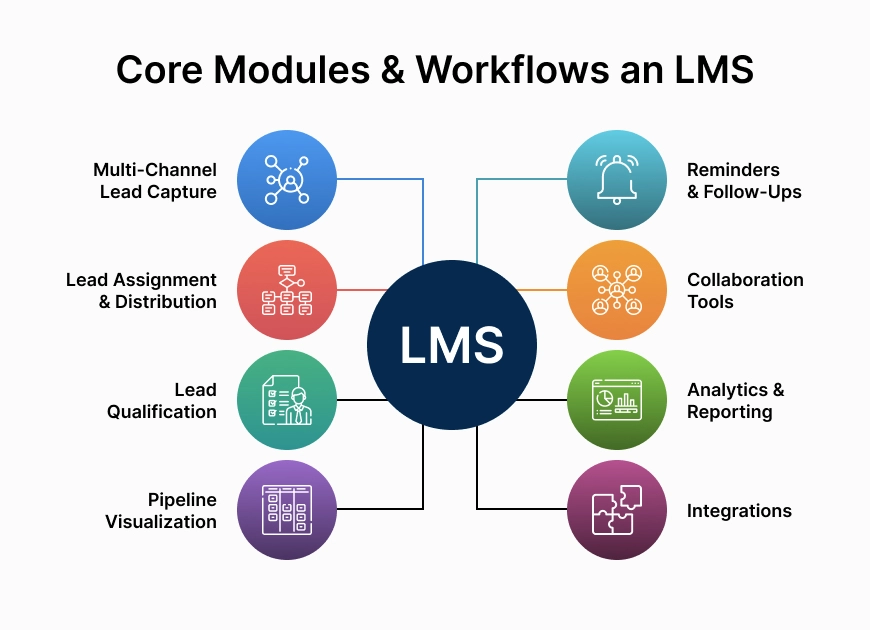
A modern LMS typically includes:
- Multi-Channel Lead Capture:
- Website forms, social media, WhatsApp, exhibitions, campaigns, telephony, dealer referrals.
- Example: A contractor scans a QR code on a product brochure and submits an inquiry directly into the LMS.
- Lead Assignment & Distribution:
- Rules-based routing (by geography, product line, workload, or dealer type).
- Example: A lead from Mumbai for sanitaryware gets assigned to the Mumbai regional manager automatically.
- Lead Qualification:
- Scoring system based on interest, budget, timeline, and engagement.
- Example: A dealer asking for bulk plywood orders is prioritized over a casual consumer inquiry.
- Pipeline Visualization:
- Kanban boards, funnel views, and dashboards showing lead status (New, Contacted, Qualified, Proposal Sent, Won/Lost).
- Reminders & Follow-Ups:
- Automated notifications for reps (email, WhatsApp, mobile app).
- Example: If a rep hasn’t followed up within 24 hours, the LMS escalates the lead to a manager.
- Collaboration Tools:
- Notes, attachments, activity logs shared among sales teams.
- Analytics & Reporting:
- Conversion rates, average time-to-close, source effectiveness, sales performance tracking.
- Integrations:
- Sync with ERP (SAP, Tally, Busy), CRM (Salesforce, Zoho), DMS, or SFA tools.
Example Workflow in Action
Imagine an FMCG manufacturer running a marketing campaign.
- Capture: 200 retailer inquiries come in through WhatsApp and web forms.
- Assignment: Leads are auto-routed to regional sales reps based on pin code.
- Qualification: High-value retailers are tagged as priority leads.
- Follow-Up: Sales reps get reminders to call within 1 hour.
- Pipeline Tracking: Managers monitor progress — 150 contacted, 100 qualified, 70 proposals sent, 50 closed.
- Integration: Closed leads flow into ERP for billing and stock dispatch.
This ensures zero leakage, faster response times, and data-driven decision-making.
Why LMS is More Than Just Software
An LMS isn’t just a tool — it’s a discipline. It enforces sales hygiene by:
- Standardizing how leads are captured and tracked.
- Making sales reps accountable for follow-ups.
- Giving managers a single source of truth.
- Building dealer trust through faster, transparent communication.
In manufacturing, where margins are tight and competition is fierce, this discipline can be the deciding factor between growth and stagnation.
Challenges Manufacturers Face Without an LMS
Manufacturers operate in dynamic and highly competitive markets. Whether it’s FMCG, paints, wires and cables, automotive, or home appliances, every industry shares a common pain point: the inability to manage leads effectively without a dedicated system. Below are the most pressing challenges manufacturers face when they try to run lead management manually.
Lost Opportunities Due to Lead Leakage
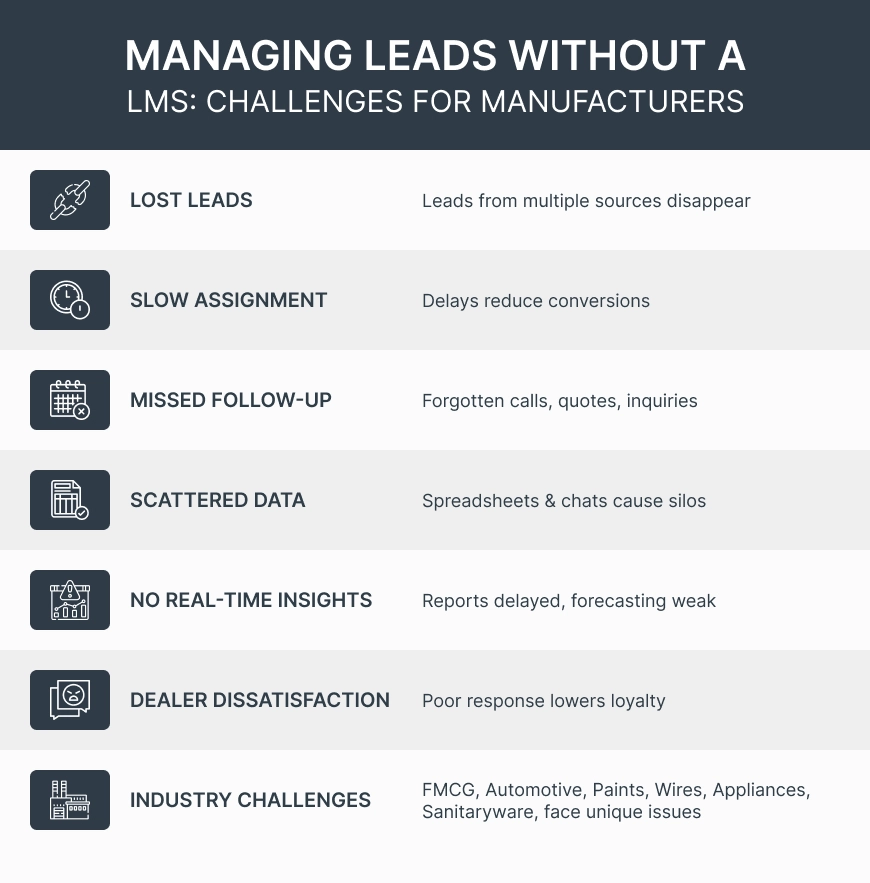
One of the biggest issues in traditional manufacturing sales processes is lead leakage. Leads come from multiple touchpoints — exhibitions, dealer referrals, website forms, WhatsApp inquiries, service calls, or campaigns. Without an LMS to centralize capture, many of these leads disappear.
- Example: A paint manufacturer collects leads at a trade show but fails to import them quickly. By the time the sales team follows up, competitors have already won the deal.
- Another case: A wire and cable dealer sends inquiries over WhatsApp, but because it’s not logged in a structured system, the inquiry is forgotten.
Lead leakage is not just about losing one order — it’s about losing long-term relationships, market credibility, and potential repeat revenue.
Slow and Inefficient Lead Assignment
Manual lead assignment causes delays. Managers often forward inquiries via email or chat, which slows down response time. Research shows that if a lead is not contacted within the first 60 minutes, the chances of conversion drop significantly.
- In FMCG, retailers expect instant acknowledgment of inquiries. A delayed response makes them switch suppliers.
- In automotive components, an OEM may need a quick proposal to finalize procurement. Delayed assignment risks losing the entire contract.
An LMS ensures instant lead routing using predefined rules — geography, product category, pin code, or dealer type — minimizing delays.
Poor Follow-Ups and Missed Deals
Without automation, follow-ups depend on the memory and discipline of individual sales reps. Human error leads to:
- Missed callbacks.
- Forgetting to send quotations.
- Delayed responses to dealer questions.
For example, a sanitaryware dealer who does not receive a follow-up within a day may assume the manufacturer is uninterested. Competitors who act faster will secure the order.
Scattered Data and Siloed Systems
When manufacturers use spreadsheets, emails, and WhatsApp to track leads, data is scattered. Managers cannot see the complete journey of a lead.
- No visibility into which source generated the most leads.
- No understanding of why deals are lost.
- No consolidated dashboard for leadership to make decisions.
This fragmentation not only hurts sales but also hampers marketing ROI analysis. Without knowing which campaigns work, marketing budgets are wasted.
Lack of Real-Time Analytics
In today’s competitive markets, managers need instant insights — which region is performing well, which products are converting, and which reps are underperforming. Without LMS dashboards:
- Reports are delayed and inaccurate.
- Forecasting becomes guesswork.
- Decision-making is reactive, not proactive.
For instance, a home appliances company launching a new product line cannot track inquiries in real time, making it impossible to adjust strategy quickly.
Dealer and Distributor Dissatisfaction
Dealers are the backbone of manufacturing sales. If their inquiries are delayed, ignored, or handled poorly, dissatisfaction grows. This leads to:
- Lower engagement in promotions.
- Reduced loyalty to the manufacturer.
- Higher chances of switching to competitors.
An LMS improves dealer trust by ensuring quick responses, transparent communication, and better visibility into lead status.
Industry-Specific Challenges Without LMS
FMCG:
- Thousands of leads from retailers daily. Without automation, sales reps cannot prioritize.
- Manual follow-ups lead to lost opportunities in competitive markets.
Automotive Components:
- RFQs from OEMs and spare-part dealers need quick attention. Manual systems often miss deadlines.
- Service inquiries for warranty or replacements go untracked.
Paints & Adhesives:
- Painter and influencer programs generate hundreds of referrals. Without LMS, tracking authenticity and rewarding influencers becomes a nightmare.
Wires & Cables:
- Project-based leads need detailed BOQ tracking. Without a system, it’s difficult to monitor status across states.
Home Appliances:
- Consumer warranty activations are often unlinked to sales leads. Manufacturers lose cross-sell/upsell opportunities.
Sanitaryware & Ceramics:
- Large construction projects involve multiple decision-makers. Without structured tracking, manufacturers lose visibility into project progress.
Unreliable Forecasting and Revenue Planning
Manual lead tracking leads to weak forecasting. Sales managers often overestimate or underestimate pipeline health because:
- Leads are not tracked consistently.
- Stages of the funnel are not updated.
- Lost reasons are not recorded.
As a result, manufacturing companies cannot plan production, inventory, or distribution effectively.
High Operational Costs
Ironically, manual lead management looks “cheap” but actually increases costs:
- Sales teams spend time chasing leads across channels.
- Managers spend hours consolidating data into reports.
- Lost leads equal lost revenue opportunities.
In contrast, an LMS automates these processes, reduces effort, and improves ROI.
Competitive Disadvantage
Finally, without LMS, manufacturers simply cannot compete in a digital-first market. Competitors who adopt modern systems:
- Respond faster.
- Provide better dealer experiences.
- Forecast more accurately.
- Gain loyalty through structured processes.
Companies without LMS are left behind, struggling with inefficiencies that customers no longer tolerate.
Core Features of an Effective LMS
A Lead Management System (LMS) is more than just a digital notebook for storing inquiries. For manufacturers dealing with complex dealer networks, multiple product lines, and region-specific sales strategies, an LMS must be robust, intelligent, and scalable. Below are the core features that define an effective LMS for manufacturers in today’s digital-first market.
Multi-Channel Lead Capture
In manufacturing, leads flow in from diverse channels — websites, mobile apps, exhibitions, dealer referrals, WhatsApp campaigns, call centers, and influencer programs. Without centralized capture, many of these leads vanish into silos.
- Why it matters: Manufacturers often spend heavily on marketing and exhibitions. If leads aren’t captured systematically, ROI suffers.
- Example: A paint manufacturer running a Facebook campaign collects thousands of responses. An LMS automatically imports them, tags the campaign source, and ensures instant routing.
- Key capabilities:
- Website & landing page integration with UTM tracking.
- WhatsApp and SMS capture through APIs.
- QR code scans on brochures, packaging, or trade-show booths.
- Call center/IVR integration.
- Dealer and distributor portals to submit inquiries.
Automated Lead Assignment
Manual lead distribution wastes time. An LMS uses rules-based routing to ensure every lead reaches the right rep instantly.
- Why it matters: Speed of response is directly linked to conversion rates.
- Example: A sanitaryware inquiry from Pune is auto-assigned to the Pune regional manager based on pin code. If not acknowledged within 30 minutes, the lead escalates to a supervisor.
- Key capabilities:
- Routing by geography, product, territory, or dealer type.
- Round-robin assignment to balance workload.
- Auto-escalation for SLA breaches.
- Integration with distributor portals for handoffs.
Lead Scoring & Qualification
Not every lead has equal potential. An LMS uses scoring models (AI/ML-driven in advanced systems) to prioritize high-value inquiries.
- Why it matters: Sales teams focus on the most promising leads instead of wasting time on low-quality ones.
- Example: A large automotive OEM requesting bulk parts gets a higher score than a single-retailer inquiry.
- Scoring parameters:
- Budget, Authority, Need, Timeline (BANT).
- Engagement behavior (email opens, link clicks, website visits).
- Lead source (referral vs cold inquiry).
- Historical purchase trends.
Pipeline Visualization
Sales leaders need visibility into where each lead stands in the sales cycle. LMS offers Kanban boards and funnel views that make the pipeline transparent.
- Why it matters: Helps identify bottlenecks — are leads stuck at “Proposal Sent”? Are too many being lost at “Qualification”?
- Example: An FMCG company sees that 40% of retail leads are stuck at the “Contacted” stage. Managers intervene with follow-up campaigns.
- Features include:
- Drag-and-drop pipeline stages.
- Real-time conversion ratios.
- Forecasting dashboards.
Mobile Accessibility for Field Sales Teams
For manufacturing reps traveling across regions, mobile-first accessibility is crucial.
- Why it matters: Salespeople on the road need instant updates and offline access in low-network zones.
- Example: A wire and cable rep logs a site visit offline in a rural area; the system syncs automatically when connectivity is restored.
- Mobile features:
- Geo-tagged check-ins.
- Beat-plan suggestions based on hot leads.
- Voice-to-text note-taking.
- Nearby lead alerts.
Automated Reminders & Follow-Ups
Reps often forget to follow up without automation. LMS provides automatic reminders for calls, emails, meetings, and quotations.
- Why it matters: Consistent follow-up dramatically improves conversion rates.
- Example: A home appliances rep is reminded to send a warranty-linked cross-sell proposal 24 hours after a product demo.
Collaboration & Dealer Visibility
Manufacturers need alignment between internal sales teams and external partners. An LMS provides shared visibility.
- Why it matters: Dealers and distributors expect real-time updates on the leads they refer.
- Example: A distributor submits 20 leads through the portal. They can track progress, see status updates, and receive credit for successful conversions.
Reporting & Advanced Analytics
Without data, managers cannot steer strategy. An LMS delivers real-time analytics.
- Why it matters: Enables leaders to measure ROI, track campaign success, and coach sales reps.
- Example: A paints manufacturer discovers that influencer referrals from painters convert 3x better than generic campaigns — so they increase investment in influencer programs.
- Reports include:
- Lead source ROI.
- Conversion rates by product, region, and campaign.
- First Response Time (FRT).
- Sales rep performance dashboards.
ERP/SAP Integration
For manufacturers, leads don’t end with conversion — they flow into ERP for invoicing, dispatch, and warranty registration. An LMS must integrate seamlessly.
- Why it matters: Prevents duplication, errors, and delays.
- Example: Once a plywood dealer’s lead is marked as “Won,” the system auto-creates a sales order in SAP.
Security & Compliance
Data privacy is critical, especially with regulations like GDPR and India’s DPDP Act. An LMS must ensure data security.
- Why it matters: Dealers and customers must trust that their data is safe.
- Features:
- Role-based access controls.
- Field-level permissions.
- Data encryption (at rest and in transit).
- Consent capture.
Bringing It All Together
An effective LMS combines all these features into a single, intuitive platform. For manufacturers, the ideal system is:
- Centralized – one source of truth for all leads.
- Automated – minimal manual effort, maximum speed.
- Scalable – works for SMEs and large enterprises alike.
- Integrable – connects smoothly with ERP, CRM, and marketing tools.
- Mobile-First – designed for on-the-go sales teams.
Benefits of LMS for Manufacturers
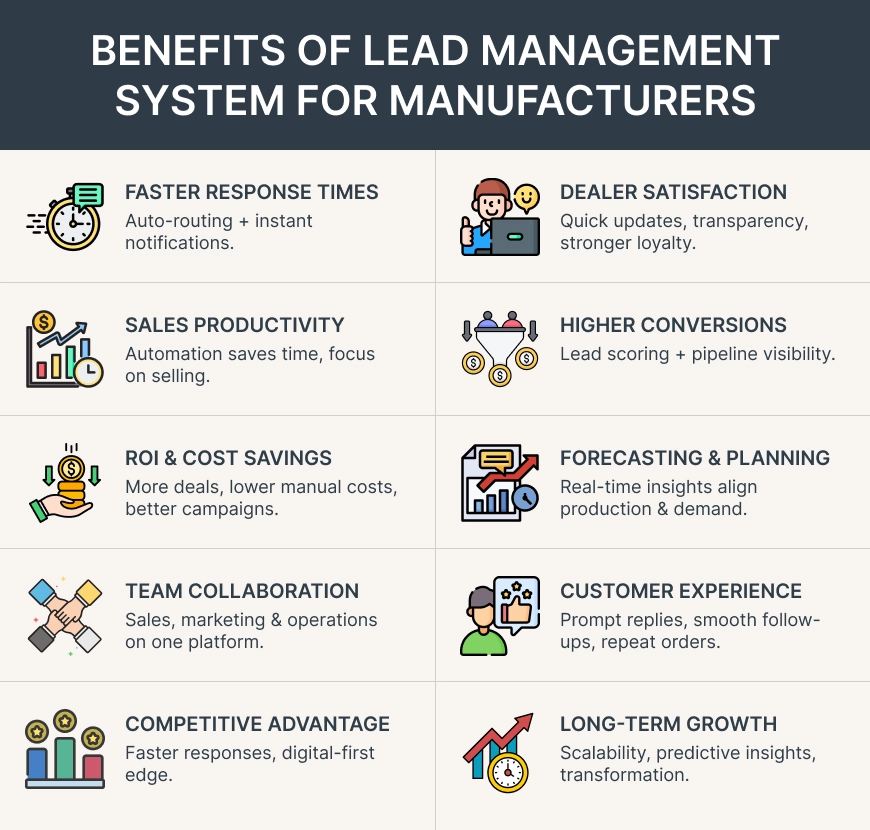
Implementing a Lead Management System (LMS) in a manufacturing environment is not just about automation — it’s about transforming the way opportunities are handled from the first inquiry to the final deal. Manufacturers who adopt LMS gain a strategic advantage across sales efficiency, dealer relationships, and overall business growth. Let’s break down the key benefits.
Faster Response Times = Higher Conversions
In manufacturing sales, speed is everything. A dealer or contractor making an inquiry often evaluates multiple suppliers. The first company to respond promptly earns trust and dramatically increases its chances of winning.
- Challenge without LMS: Manual lead assignment creates delays of hours or even days.
- Benefit with LMS: Leads are auto-routed instantly, and sales reps receive notifications to respond immediately.
Real-world impact: Studies show that responding to a lead within the first hour makes you 7x more likely to close the deal. In industries like paints, FMCG, or automotive components, this speed creates a decisive edge.
Improved Dealer & Distributor Satisfaction
Dealers are the backbone of most manufacturing businesses. When their inquiries are handled quickly, transparently, and with regular updates, loyalty increases.
- Without LMS: Dealers feel neglected when inquiries go unanswered.
- With LMS: They can log inquiries directly, track status, and receive updates.
Example: A plywood dealer submits 10 inquiries through a portal. With LMS, they can view progress (5 proposals sent, 3 qualified, 2 converted). This visibility improves trust and ensures long-term loyalty.
Increased Sales Productivity
Sales teams spend enormous time manually logging leads, updating spreadsheets, and chasing follow-ups. LMS automates these low-value tasks, freeing reps to focus on selling.
- Auto-reminders for follow-ups.
- One-click access to past interactions.
- Mobile apps for quick updates on the go.
Result: Reps close more deals in less time. Managers gain clarity without asking for manual reports.
Higher Conversion Rates
With structured workflows, prioritized leads, and consistent follow-ups, conversion rates naturally rise.
- Lead Scoring: Ensures reps focus on high-potential inquiries.
- Pipeline Visibility: Managers can intervene where leads get stuck.
- Automation: Reduces human error and missed opportunities.
Example: An automotive components company increased conversion by 30% after deploying an LMS that flagged high-value RFQs for priority handling.
ROI and Cost Savings:
An LMS is not an expense — it’s an investment with measurable returns.
- Direct ROI: More leads converted into deals.
- Indirect ROI: Lower operational costs (less manual effort, fewer missed opportunities).
- Campaign ROI: Clear visibility into which marketing channels generate the best leads.
Case insight: An FMCG company discovered that WhatsApp campaigns brought in 3x more conversions than email. This insight was only possible with LMS analytics.
Better Forecasting & Planning
Manufacturers often struggle with demand forecasting. Without reliable lead data, production planning and inventory management suffer.
- LMS provides real-time insights into pipeline health.
- Managers know how many deals are likely to close in the next quarter.
- This allows factories to align production schedules with actual demand.
Result: Reduced stockouts, better cash flow, and optimized distribution.
Stronger Collaboration Across Teams
Sales, marketing, and operations often work in silos. An LMS breaks these silos by acting as a single source of truth.
- Marketing can see which campaigns generated high-quality leads.
- Sales can log every interaction, visible to managers and peers.
- Operations can prepare for orders earlier based on probable closures.
Enhanced Customer Experience
Even in manufacturing, customer experience matters. When inquiries are handled promptly, with personalized communication and smooth follow-ups, customers are more likely to return.
- Automated WhatsApp acknowledgments.
- Quick proposal sharing.
- Transparent communication through dealer portals.
Result: Stronger relationships, repeat orders, and positive word-of-mouth.
Competitive Advantage in Digital-First Markets
Competitors adopting digital tools already respond faster, track better, and serve dealers more effectively. An LMS ensures you don’t fall behind.
- Example: A hardware manufacturer using LMS can respond to 90% of inquiries within an hour, while traditional competitors take days. The difference directly translates into market share.
Real-World Case Scenarios
Scenario 1: FMCG Manufacturer
Problem: Thousands of retailer inquiries daily, many untracked.
Solution: LMS with IVR/WhatsApp capture, automated assignment by territory.
Result: 25% increase in active retailers, 40% faster response time.
Scenario 2: Paints & Adhesives
Problem: Difficulty tracking painter referrals and rewarding influencers.
Solution: LMS linked with influencer program and QR code validation.
Result: 3x increase in verified influencer leads, stronger loyalty among painters.
Scenario 3: Automotive Components
Problem: Delayed responses to RFQs from OEMs.
Solution: LMS with SLA-based assignment and escalation.
Result: 30% higher conversion of bulk orders.
Long-Term Strategic Benefits
Beyond immediate gains, LMS provides manufacturers with long-term advantages:
- Scalability: As the company grows, LMS scales with it.
- Data Insights: Years of lead data create predictive models for future strategy.
- Dealer Engagement: Stronger ecosystems of loyal dealers and distributors.
- Digital Transformation: Positions the company as a modern, technology-driven brand.
In summary, an LMS is not just about managing leads — it’s about empowering manufacturers to grow faster, serve dealers better, and compete smarter.
Industry Applications of LMS
A Lead Management System (LMS) is versatile and adaptable across industries. However, each sector has unique challenges and workflows. Below, we explore how LMS solves problems in different manufacturing verticals with practical use cases.
Wires & Cables
Challenges:
- Project-based inquiries with detailed BOQs (Bill of Quantities).
- Leads coming from EPC contractors, builders, and dealers spread across regions.
- Manual tracking makes it difficult to follow up on large tenders.
How LMS Helps:
- QR codes on catalogs capture inquiries directly into LMS.
- Leads assigned by voltage class, region, or contractor type.
- Site visit tasks created automatically for technical teams.
- Managers get dashboards showing which projects are at quotation vs negotiation.
Practical Example: An EPC contractor submits an inquiry at an exhibition. The LMS routes it to the correct regional manager, logs BOQ details, and sets a 48-hour SLA for quotation. Managers track whether the quote is sent on time and escalate if delayed.
FMCG (Fast-Moving Consumer Goods)
Challenges:
- Thousands of retailer inquiries daily.
- Difficult to prioritize between small shops and large retailers.
- Distributors need visibility into retailer onboarding.
How LMS Helps:
- IVR and WhatsApp channels capture retailer leads instantly.
- Automated assignment routes high-potential retailers to senior reps.
- Distributor portals allow them to submit and track retailer referrals.
- Campaign ROI visible: which promotions generate the most retailers.
Practical Example: During a festive campaign, 5,000 leads come in. LMS auto-sorts them by pin code, prioritizes those from metro cities, and routes them to the right reps. Distributors can track progress and ensure their referrals are credited.
Paints & Adhesives
Challenges:
- Dependence on influencers like painters and contractors.
- Difficulty tracking referral authenticity.
- Seasonal spikes in demand.
How LMS Helps:
- QR code validation for painter referrals ensures authenticity.
- Influencer points or rewards linked to successful lead conversion.
- Seasonal campaign tracking (e.g., monsoon waterproofing promotions).
- Regional dashboards show city-wise demand.
Practical Example: A painter refers five homeowners via a QR-based program. LMS tracks referrals, confirms authenticity, and auto-credits loyalty points once jobs are verified.
Automotive & Components:
Challenges:
- Large RFQs (Request for Quotations) from OEMs.
- Spare part distributors needing quick order responses.
- Warranty/service leads that get lost without tracking.
How LMS Helps:
- SLA-driven lead assignment ensures RFQs are responded to within 24 hours.
- Warranty claims linked directly to customer records.
- Service inquiries logged, tracked, and escalated automatically.
- Sales reps use mobile apps to log workshop visits.
Practical Example: An OEM requests a bulk quotation for 10,000 components. LMS flags this as a high-value lead, assigns it to the senior account manager, and sets a tight SLA. Management gets real-time updates until conversion.
Sanitaryware & Ceramics
Challenges:
- Large construction projects with multiple stakeholders.
- Leads from architects, builders, and contractors.
- Warranty/service inquiries often mismanaged.
How LMS Helps:
- Architect and builder leads tracked separately with project milestones.
- Service claims (like replacements) linked to warranty-registered products.
- Collaboration tools let sales, service, and distributor teams work together.
Practical Example: A builder plans a housing project requiring 1,000 bathroom units. LMS tracks every stage: initial inquiry → sample approvals → pricing → project closure → warranty registration.
Hardware & Fittings
Challenges:
- Bulk dealer inquiries across categories (locks, hinges, slides).
- High competition in pricing.
- Manual tracking makes follow-ups inconsistent.
How LMS Helps:
- Category-based lead routing ensures experts handle each product line.
- Quotation workflows built into lead stages.
- Follow-up reminders ensure no dealer inquiry is missed.
Practical Example: A dealer requests a quotation for 500 hinges. LMS assigns it to the fittings category manager, logs quotation deadlines, and escalates if not sent.
Home Appliances
Challenges:
- Leads come from consumers, dealers, and e-commerce.
- Warranty registrations and service inquiries often unlinked.
- Difficulty cross-selling or upselling after sales.
How LMS Helps:
- Consumer leads captured from websites, marketplaces, and social media.
- Warranty activations logged as leads for upsell campaigns.
- Service leads routed to nearest service centers automatically.
Practical Example: A customer buys a refrigerator and activates the warranty online. LMS captures this as a lead, assigns it to sales for upsell (water purifier combo), and ensures service inquiries are routed properly.
Composite Panels & Building Materials
Challenges:
- Contractor and architect-driven sales.
- Complex approvals needed for façade projects.
- Safety certifications must be shared promptly.
How LMS Helps:
- Contractor inquiries prioritized by project size.
- Site survey tasks auto-created for large projects.
- Technical drawings and safety certificates attached to lead records.
Practical Example: An architect specifies aluminum panels for a commercial project. LMS tracks every step from inquiry → approval → site survey → final order, ensuring documents are accessible to all stakeholders.
Power Tools & Industrial Equipment
Challenges:
- Distributor onboarding requires credential checks.
- Demo and loaner tools often mismanaged.
- AMC (Annual Maintenance Contracts) not tracked properly.
How LMS Helps:
- Distributor leads logged with verification workflows.
- Demo tools tracked as sub-items under leads.
- AMC renewals set with automated reminders.
Practical Example: A contractor requests demo tools. LMS logs the request, assigns responsibility, and tracks return deadlines. AMC renewals are scheduled automatically to avoid missed revenue.
Cross-Industry Value of LMS
Across industries, LMS provides three universal benefits:
- Centralized Capture – No more lead leakage across channels.
- Faster Responses – Dealers, contractors, and consumers get timely replies.
- Data-Driven Insights – Manufacturers finally see what’s working, what’s not, and where to invest.
Technical Capabilities of EzeOne LMS
EzeOne’s Lead Management System (LMS) is designed specifically for manufacturers and distributors who require scalability, reliability, and flexibility. Unlike generic CRM tools, EzeOne LMS is built with industry workflows in mind. Below we’ll explore its technical foundation, highlighting the features that make it a future-ready platform.
Scalable Cloud Architecture
Manufacturers handle leads in the thousands — from small dealer inquiries to multi-crore project RFQs. EzeOne LMS is hosted on a cloud-native architecture that scales effortlessly.
- Elastic infrastructure: Handles spikes during campaigns or trade shows.
- Multi-region availability: Ensures uptime even during peak loads.
- SME to enterprise-ready: Works equally well for a regional manufacturer or a global brand.
Example: During Diwali promotions, an FMCG company received 10,000+ retailer leads in a week. EzeOne LMS scaled automatically without downtime.
Multi-Login Roles & Access Control
Manufacturing sales teams are complex: super-admins, regional managers, sales reps, distributors, and even influencers. EzeOne LMS supports multi-login hierarchies.
- Super Admin: Full system visibility and control.
- Regional Manager: Access to leads within assigned states/regions.
- Sales Rep: Sees only personal leads, tasks, and follow-ups.
- Distributor Portal: Dealers/distributors can submit and track referrals.
- Influencer Access: Painters, contractors, or plumbers can submit referrals via mobile/QR.
Benefit: Ensures role-based visibility while protecting sensitive data.
AI/ML-Driven Lead Scoring
EzeOne LMS uses artificial intelligence and machine learning to evaluate lead quality.
- Scoring factors: Budget, timeline, engagement activity, referral authenticity.
- Dynamic prioritization: Reps focus on leads with the highest probability of closure.
- Predictive models: Learn from historical conversion patterns to recommend next best actions.
Example: A plywood manufacturer receives 200 dealer inquiries. AI scoring prioritizes the 30 with high budgets and genuine intent, ensuring sales reps spend time wisely.
Seamless ERP/SAP/CRM Integration
One of the biggest challenges in manufacturing is the disconnect between pre-sales and post-sales systems. EzeOne LMS bridges this gap.
- ERP (SAP, Tally, Busy, Oracle): Automatic order creation once a lead is won.
- CRM (Salesforce, Zoho, HubSpot): Syncs account/customer data for lifecycle management.
- DMS/SFA: Integrates with dealer management and sales force automation platforms.
- APIs: RESTful APIs for third-party integration (marketing automation, telephony, WhatsApp).
Example: When a lead in EzeOne LMS is marked “Closed-Won,” it instantly triggers order creation in SAP ERP and syncs customer details with CRM.
Real-Time Analytics & Dashboards
Manufacturers cannot wait weeks for sales reports. EzeOne LMS delivers real-time insights through customizable dashboards.
- KPIs tracked:
- Lead source ROI.
- First Response Time (FRT).
- Conversion rates by territory.
- Stage-wise funnel drop-offs.
- Sales rep productivity.
- Export options: PDF, Excel, or API feed to BI tools.
- Predictive analytics: Forecasts based on weighted pipelines and historical win rates.
Benefit: Managers can coach sales reps, optimize campaigns, and reallocate resources instantly.
Mobile-First with Offline Capability
Sales teams in manufacturing often travel to remote regions with poor connectivity. EzeOne LMS solves this with a mobile-first app.
- Geo-tagged check-ins: Logs rep visits with location data.
- Offline access: Leads, tasks, and notes sync automatically once the device reconnects.
- Nearby lead alerts: Suggests hot leads based on rep’s current location.
- Voice-to-text input: Reps can dictate notes after dealer visits.
Example: A sanitaryware rep in rural Bihar records visit notes offline. Once network is available, the system syncs seamlessly.
Workflow Automation Engine
Manual tasks drain sales productivity. EzeOne LMS includes a workflow engine to automate repetitive actions.
- Auto-assign leads based on rules.
- Trigger WhatsApp/email/SMS acknowledgments instantly.
- Schedule reminders for follow-ups.
- Escalate overdue tasks to managers.
Result: Consistency, accountability, and faster deal closures.
Security & Compliance
With increasing data privacy regulations (GDPR, India’s DPDP Act), security is non-negotiable.
- Data encryption: At rest and in transit.
- Role-based permissions: Restricts access to sensitive information.
- Audit trails: Every action logged for accountability.
- Consent management: Capture and store dealer/customer opt-ins.
- Data residency: Local hosting options for compliance.
Example: A European partner requires GDPR compliance. EzeOne LMS provides EU data residency and consent management to meet requirements.
Customization & Industry-Specific Modules
Unlike generic CRMs, EzeOne LMS is tailored for manufacturing use cases.
- Influencer program tracking: Painters, plumbers, or contractors.
- Project-based workflows: For BOQ-driven industries like wires, cables, and panels.
- AMC & warranty integration: For appliances, automotive, and power tools.
- Distributor credit-limit visibility: Linked with ERP.
Scalability for Future Growth
Many manufacturers start small but scale rapidly. EzeOne LMS is designed to grow with them.
- Add unlimited users, regions, and product categories.
- Handle millions of leads without performance issues.
- Integrate new digital channels (marketplaces, apps, IoT).
Bringing It Together
The technical backbone of EzeOne LMS ensures manufacturers get:
- Reliability: Uptime and scalability.
- Speed: Instant capture and assignment.
- Intelligence: AI-driven insights.
- Security: Compliance with global standards.
- Flexibility: Tailored workflows for every industry.
Why Manufacturers Should Invest Now
The global manufacturing sector is in the midst of a digital-first transformation. Buyers — whether they are dealers, distributors, contractors, or end-consumers — expect instant responses, transparent communication, and seamless digital experiences. Manufacturers who continue to rely on outdated manual processes risk losing market share to faster, more agile competitors. Here’s why now is the time to invest in a Lead Management System (LMS).
Competitive Pressure Is Intensifying
Manufacturers are no longer just competing locally; globalization and digital trade have introduced new players in every market. Dealers who once relied on legacy relationships now have choices.
- If your competitor responds to inquiries in 30 minutes and you take 2 days, who will win the deal?
- If another brand gives dealers a transparent way to track inquiries, why would they stick with you?
An LMS ensures you match or exceed competitor responsiveness. It helps you become the “preferred supplier” not because of lower prices, but because of superior experience.
Dealers and Distributors Expect Digital Engagement
Today’s dealers are more digitally savvy than ever. They are used to apps for banking, logistics, and e-commerce. They expect the same level of convenience from manufacturers.
- Dealers don’t want to wait for manual responses.
- They want visibility: “Has my inquiry been received? Who is handling it? When will I get a quotation?”
- They want incentives, credit limits, and updates tracked digitally.
By adopting an LMS, you show your channel partners that you respect their time and business. In return, they show loyalty and preference for your brand.
Digital-First Buyers Dominate the Market
In sectors like FMCG, paints, appliances, and automotive, buyers have shifted online. Trade shows still matter, but websites, WhatsApp, and mobile apps are now primary lead channels.
Without LMS:
- Web leads often sit unacknowledged.
- WhatsApp inquiries get lost in chat clutter.
- Campaign ROI is unmeasurable.
With LMS:
- Every lead is captured in real time.
- Buyers receive instant acknowledgment.
- Marketing can prove which campaigns drive revenue.
This digital-first shift is permanent. Investing now ensures you don’t fall behind.
Speed = Revenue in 2025
According to multiple studies, 74% of buyers choose the vendor who responds first. In manufacturing, this translates into crores of revenue.
- A builder deciding on ceramic fittings will go with the vendor who provides a detailed proposal first.
- A retailer choosing FMCG brands for shelves will favor the company that acknowledges orders fastest.
- A contractor finalizing wires for a project won’t wait days for pricing.
An LMS automates lead routing, reminders, and escalation, ensuring you never lose deals because of delays.
The Cost of Inaction is Rising
Some manufacturers think, “We’ll adopt LMS later.” But the cost of waiting is enormous:
- Lost deals from slow follow-ups.
- Wasted campaigns where leads aren’t captured.
- Dealer churn due to poor experience.
- Reputation damage when buyers see you as unresponsive.
Meanwhile, competitors who invest now lock in loyalty, build datasets for future AI-driven insights, and establish themselves as digital leaders.
Aligning With Future Trends
An LMS is not just a short-term fix — it is the foundation for future-ready sales operations. By investing now, manufacturers prepare for:
- AI-driven lead scoring: Smarter prioritization over time.
- IoT integration: Leads triggered directly from connected products.
- Voice-enabled engagement: Faster follow-ups with assistants.
- Predictive forecasting: Data-driven production and distribution planning.
Waiting means starting from scratch when these technologies become mainstream. Investing now means you’re already ahead of the curve.
Tangible ROI Within Months
Unlike large ERP rollouts, LMS adoption is quick and measurable.
- Typical manufacturers see ROI in 3–6 months.
- Faster responses → higher conversion rates.
- Lower manual workload → more productive teams.
- Transparent processes → happier dealers.
This makes LMS one of the highest-ROI digital investments available today.
The manufacturing industry is at a turning point. Traditional methods cannot keep pace with digital-first buyers, demanding dealers, and aggressive competitors. Now is the time to invest in a Lead Management System — not in two years, not when “things settle down.”
Manufacturers who act now will
- Win more deals.
- Strengthen dealer networks.
- Forecast with accuracy.
- Build a future-ready digital foundation.
Those who delay risk becoming irrelevant in markets where speed and transparency are everything.
Future of Lead Managment System (LMS)
The manufacturing industry is evolving at an unprecedented pace. Technologies like artificial intelligence (AI), the Internet of Things (IoT), predictive analytics, and voice-enabled tools are reshaping how businesses engage with customers and manage opportunities. A Lead Management System (LMS) of the future will no longer be just a tool to capture and track leads — it will be an intelligent growth engine.
AI-Driven Lead Intelligence
Future LMS platforms will use artificial intelligence to go beyond basic scoring. Instead of just ranking leads by engagement, AI will:
- Analyze historical data to predict which leads are most likely to convert.
- Suggest the “next best action” for reps (e.g., call now, send a proposal, escalate).
- Detect patterns of churn risk in dealers and alert managers early.
Example: An automotive component manufacturer receives 500 inquiries. AI instantly flags 50 high-priority RFQs based on customer history, budget signals, and previous win/loss patterns.
IoT Integration for Real-Time Triggers
IoT will allow machines and products to become sources of leads themselves.
- Smart equipment can automatically trigger a service lead when maintenance is due.
- Connected appliances can send alerts when warranty renewals or consumables are required.
- Dealers can scan IoT-enabled QR codes on packaging to register sales or generate leads.
Example: A water purifier manufacturer integrates IoT sensors. When a filter needs replacement, the system automatically creates a lead for service teams, who contact the customer before they even complain.
Predictive Analytics for Forecasting
Forecasting in manufacturing will become data-driven, not assumption-driven.
- Predictive analytics will combine lead data with historical sales and market trends.
- Managers will know not only how many leads they have but also the probability of closure by product, region, or channel.
- This will allow factories to align production schedules and supply chains with real demand.
Example: A plywood manufacturer uses predictive models to forecast demand in urban vs rural regions, optimizing production to prevent stockouts.
Voice-Enabled Lead Tracking
Sales teams often struggle with data entry. Voice-enabled technology will make LMS hands-free and faster.
- Reps can log visit notes using speech-to-text.
- Managers can ask: “Show me all leads in negotiation in Delhi region” — and the LMS responds instantly.
- Voice reminders will alert reps to follow up with dealers.
Example: A field sales rep driving between dealer visits uses voice commands to update lead status without stopping.
Hyper-Personalization of Dealer Engagement
The LMS of the future will personalize communication for every dealer and influencer.
- Automated WhatsApp messages will adapt tone and content to the dealer’s history.
- Loyalty and incentive schemes will be tailored based on past purchases.
- Dynamic proposals will be auto-generated, customized by region, stock, and pricing.
Integration with Emerging Ecosystems
Tomorrow’s LMS will integrate with:
- E-commerce & B2B marketplaces (Amazon Business, IndiaMART).
- Logistics platforms to track dispatch and delivery against leads.
- Digital payment systems for instant order closure.
This end-to-end integration will eliminate manual handoffs and make the lead-to-order journey completely seamless.
Conclusion of This Section: The future of LMS is intelligent, automated, and proactive. Instead of just tracking leads, it will:
- Predict buyer behavior.
- Automate repetitive tasks.
- Engage dealers with hyper-personalization.
- Connect directly with IoT devices, marketplaces, and logistics.
For manufacturers, adopting LMS today is not just about solving current pain points — it is about building the foundation for this AI-driven, IoT-connected future.
Frequently Asked Questions (FAQs)
Below are some of the most common questions manufacturers ask about Lead Management Systems (LMS) and how they fit into their sales ecosystem.
Q1: Is a Lead Management System the same as a CRM?
Ans: No. A CRM manages the full customer lifecycle — from sales to after-sales service and loyalty. An LMS focuses only on the pre-sales journey: capturing, qualifying, assigning, and converting leads. Many manufacturers use LMS + CRM together for maximum impact.
Q2: Can LMS integrate with ERP systems like SAP, Tally, or Busy?
Ans: Yes. A good LMS, like EzeOne’s, integrates seamlessly with ERP platforms. When a lead is marked “Closed-Won,” the system can automatically create a sales order in SAP or Tally. This prevents double data entry and speeds up dispatch and invoicing.
Q3: Which industries benefit the most from LMS?
Ans: While every manufacturing sector benefits, some industries see faster ROI:
- FMCG: Handles thousands of retailer leads daily.
- Paints & Adhesives: Manages influencer referrals.
- Automotive: Tracks RFQs and warranty claims.
- Wires & Cables: Handles project BOQs.
- Home Appliances: Manages warranty-linked leads.
Q4: How does LMS improve sales productivity?
Ans: LMS automates repetitive tasks like assigning leads, sending reminders, and generating reports. Sales reps spend less time on admin and more time on selling. Managers gain visibility into performance without chasing manual updates.
Q5: How quickly can a manufacturer see ROI from LMS?
Ans: Most manufacturers see ROI within 3–6 months. Faster responses increase conversions, while better tracking reduces leakage. Marketing ROI also improves because campaigns are measured more effectively.
Q6: Is LMS useful for small and medium-sized manufacturers, or only large enterprises?
A: LMS is scalable. SMEs benefit by organizing leads without needing a large IT team, while large enterprises use LMS to handle complexity across multiple regions and product lines.
Q7: Can dealers and distributors directly interact with LMS?
Ans: Yes. EzeOne LMS includes dealer/distributor portals where partners can submit leads, track progress, and get credit for conversions. This transparency builds loyalty and prevents disputes.
Q8: Does LMS work on mobile devices?
A: Absolutely. EzeOne LMS is mobile-first with offline capabilities. Reps can update leads during field visits, log geo-tagged check-ins, and sync data once online.
Q9: How does LMS ensure data security and compliance?
Ans: Security is built into the architecture. Features include:
- Role-based access control.
- Data encryption (in transit and at rest).
- Audit trails.
- Consent capture for GDPR and DPDP compliance.
Q10: What KPIs should manufacturers track in LMS?
Ans: Some essential KPIs include:
- First Response Time (FRT).
- Percentage of leads contacted within SLA.
- Conversion rates by product, region, or campaign.
- Pipeline velocity (average days to close).
- Dealer/distributor satisfaction scores.
Q11: How does LMS support influencer or loyalty programs?
Ans: Influencers like painters, plumbers, or contractors can submit leads directly into LMS via QR codes or mobile apps. Successful conversions automatically trigger loyalty points or rewards, creating a closed-loop incentive system.
Q12: What happens if a sales rep leaves the company?
Ans: Unlike manual systems where leads are lost, LMS ensures all data (conversations, notes, files, commitments) stays in the system. This protects business continuity and ensures smooth handover.
Conclusion
The manufacturing world is changing. Success is no longer determined by who has the largest factory or widest distribution network — it’s determined by who responds faster, serves dealers better, and uses data to make smarter decisions.
A Lead Management System (LMS) provides the foundation for this transformation. By centralizing every inquiry, automating assignments, prioritizing high-value opportunities, and giving managers real-time visibility, LMS ensures no lead is ever wasted.
For manufacturers across industries — from wires & cables to FMCG, paints & adhesives, automotive, home appliances, sanitaryware, and beyond — LMS is the difference between reacting slowly and winning consistently.
At EzeOne Technologies, our LMS is purpose-built for manufacturing workflows. It combines AI-driven intelligence, multi-channel capture, ERP/SAP integration, dealer portals, mobile-first accessibility, and enterprise-grade security — all tailored to the unique challenges of manufacturers and distributors.
👉 Now is the time to act. Competitors are already digitizing their sales processes. Waiting means lost opportunities, dissatisfied dealers, and slower growth.
Take the next step toward sales excellence and dealer loyalty.
✅ Book a free demo with EzeOne Technologies today and see how our Lead Management System can help you capture more leads, convert faster, and grow smarter.