Top 3 Reasons Sales Forecasting Fails in the Manufacturing Industry

Why Forecasting Is Critical in Manufacturing
Sales forecasting has always been at the heart of successful manufacturing businesses. It is not only about predicting numbers but also about aligning production, workforce, and financial planning to meet real-world demand. Accurate forecasting ensures that manufacturers strike the right balance between supply and demand. In industries like FMCG, hardware, plywood, paints, sanitaryware, and automotive components, even a 5% forecasting error can mean millions lost due to stockouts or overproduction.
Manufacturers in India and globally are waking up to the fact that forecasting is no longer a quarterly or annual exercise—it needs to be dynamic, real-time, and data-driven. Without it, businesses risk missed opportunities, dealer dissatisfaction, and high operational costs.
The Importance of Accurate Forecasting in 2025
Forecasting in 2025 is not just about sales prediction—it is about ensuring the entire supply chain is agile and responsive. In a manufacturing environment where raw material costs fluctuate, consumer demand changes rapidly, and global disruptions are common, accurate forecasting becomes a competitive weapon. Companies that adopt modern forecasting techniques can outpace rivals by reducing costs and improving customer trust.
Accurate forecasting provides manufacturers with:
- Better operational efficiency by aligning labor and material planning.
- Stronger financial discipline by reducing excess stock.
- Enhanced dealer and distributor confidence.
- Greater adaptability to market shocks.
Reason 1: No Real-Time Visibility from the Ground Team
The most common reason forecasts fail is the lack of live, accurate data from field sales teams. Managers often depend on outdated spreadsheets or delayed WhatsApp updates from sales reps. By the time this data reaches leadership, it is already too late to take corrective actions. For manufacturers, this delay directly impacts production planning and order allocation.
For example, a sanitaryware company may believe its North Zone sales are steady, only to realize at month-end that dealer orders dropped sharply in week two. Without live tracking, they cannot correct production or adjust promotions in time.
How to Fix It:
- Implement Sales Force Automation (SFA) tools.
- Enable geo-tagged attendance and order booking via mobile apps.
- Provide managers with live dashboards.
- Automate alerts for missed dealer follow-ups.
Reason 2: Dealers and Distributors Don’t Share Timely Data
Dealers form the backbone of most manufacturing supply chains, yet many manufacturers struggle because dealers delay or underreport data. This creates forecasting blind spots where companies cannot see real demand signals. Dealers may also hold back information to negotiate better schemes or incentives. The result is poor stock allocation and lost opportunities.
For example, in the paints and adhesives industry, a delayed dealer report could mean the manufacturer misses out on leveraging seasonal demand in festive months.
How to Fix It:
- Deploy a Dealer Management System (DMS) where dealers place orders directly.
- Provide dealers with dashboards to view schemes and track claims.
- Incentivize dealers with loyalty rewards for timely reporting.
- Integrate dealer order data directly into forecasting systems.
Reason 3: Gut Feeling Over Data
Another major pitfall is when leaders rely on intuition or last year’s numbers to make forecasts. While experience is valuable, market conditions are too volatile to depend on gut feeling alone. Consumer preferences, competitor discounts, and regulatory changes can all invalidate past assumptions. Relying on outdated methods often results in either overproduction or missed sales opportunities.
How to Fix It:
- Use CRM and SFA data for real-time insights.
- Track conversion rates, lead pipelines, and repeat orders.
- Leverage 3–5 years of historical sales data, combined with current dealer engagement, for predictive accuracy.
- Introduce AI-driven analytics to forecast demand more reliably.
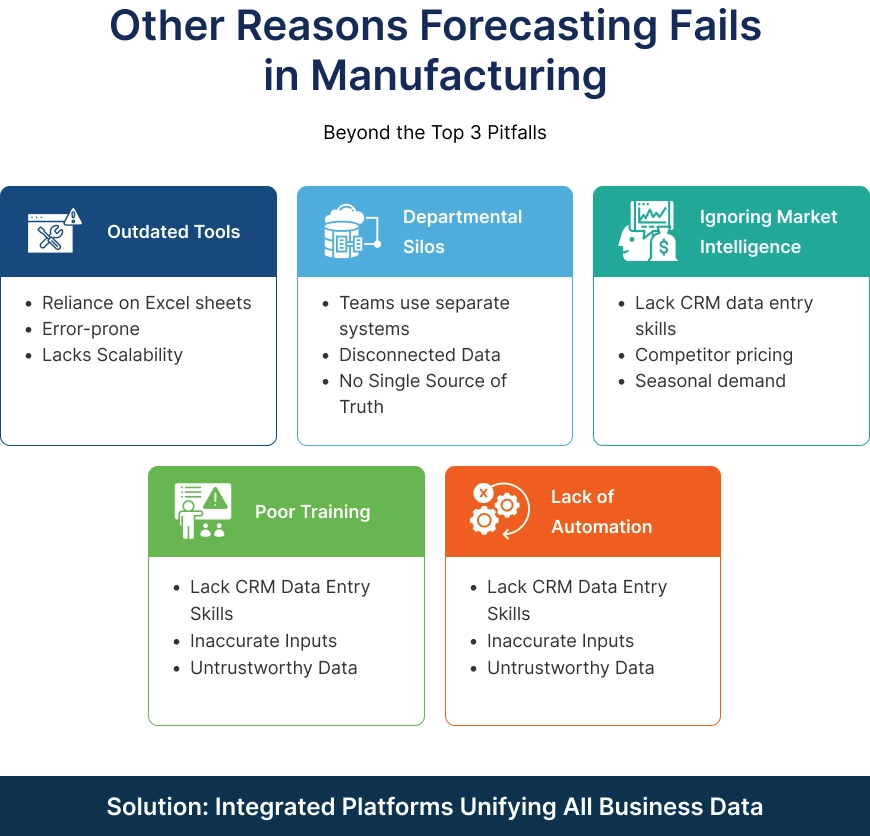
Other Reasons Forecasting Fails in Manufacturing
Beyond the top three, several other reasons contribute to inaccurate forecasting:
- Outdated Tools: Heavy reliance on Excel sheets, which are error-prone and lack scalability.
- Departmental Silos: Sales, finance, and warehouse teams using disconnected systems.
- Ignoring Market Intelligence: Competitor pricing, seasonal demand, and consumer behavior often excluded.
- Poor Training: Sales reps not trained to input accurate CRM data.
- Lack of Automation: Delayed manual entries instead of automated syncing.
Addressing these requires a shift towards integrated platforms that unify data across all business functions.
How EzeOne Suite Supports Accurate Forecasting
EzeOne Technologies provides manufacturers with a complete automation suite to transform forecasting. By combining SFA, DMS, CRM, and WMS, manufacturers gain one unified ecosystem where every sales touchpoint feeds into forecasting models.
EzeOne Suite ensures:
- Sales Force Automation: Real-time capture of field data.
- Dealer Management System: Dealer orders logged instantly.
- CRM: Pipeline and conversion visibility.
- Warehouse Management: Stock levels aligned with demand.
- Loyalty Systems: Incentivizing reporting and dealer participation.
Together, these systems eliminate guesswork and enable data-driven forecasting.
Tools That Power Your Forecasting:
| Tool | What It Does |
|---|---|
| Sales Force Automation | Captures field sales activities in real time |
| Dealer Management System | Digitally connects your brand with all dealers/distributors |
| Lead Management System | Organizes, assigns, and tracks sales leads |
| Warehouse Management System | Tracks dispatches and inventory across locations |
| Loyalty & Rewards Management | Keeps channel partners engaged and active |
| Warranty & Support System | Tracks post-sales issues and repeat complaints |
By using these tools together, manufacturers can eliminate manual errors, get clean real-time data, and forecast better.
The Real-World Impact of Better Forecasting
The future is moving toward intelligent, predictive systems powered by artificial intelligence and machine learning. Manufacturers that adopt these innovations will enjoy a significant advantage.
Before EzeOne Suite:
- Sales reps send updates via WhatsApp
- Dealers call in orders and scheme queries
- Warehouse struggles with overstocking taps and understocking valves
- You missed your Q3 target because demand picked up in one region but you didn’t know in time
After EzeOne Suite:
- Reps log every order in real-time
- Dealers order directly via portal
- Management tracks live dispatches, dealer activity, and stock levels
- Forecasts are updated weekly, not quarterly
Result: 10–25% improvement in forecast accuracy, faster order fulfilment, better channel satisfaction, and reduced inventory waste.
Bonus Tips to Improve Forecasting Even Further
- Update Forecasts Weekly – Not just once a month.
- Train Your Sales Team – Teach them the value of accurate CRM inputs.
- Reward Dealer Reporting – Give points for timely updates.
- Use Mobile Dashboards – Let sales heads view data on the go.
- Run Forecast vs Actual Reports – Improve accuracy over time.
Sales forecasting isn’t a luxury—it’s the backbone of every manufacturing business. Whether you produce faucets, fasteners, plywood, or paints, your profitability depends on planning the right quantity at the right time.
Frequently Asked Questions (FAQs)
Q1: What is sales forecasting in manufacturing?
A: It is the process of predicting sales demand to align production, inventory, and distribution.
Q2: Why do forecasts fail?
A: Due to outdated tools, delayed dealer data, and reliance on gut feeling instead of real-time insights.
Q3: How does automation improve forecasting?
A: Automation ensures real-time data flow from sales reps, dealers, and warehouses.
Q4: Is forecasting only for large enterprises?
A: No, even mid-sized manufacturers gain from demand planning.
Q5: What role does AI play in forecasting?
A: AI enables predictive analytics and deeper accuracy, especially in volatile markets.
Stop Guessing, Start Forecasting Smarter
Forecasting is no longer optional—it is central to profitability in manufacturing. Manual methods and gut-driven predictions have no place in 2025. By adopting automation tools such as SFA, DMS, CRM, and WMS, manufacturers can finally achieve forecasting accuracy that drives growth, reduces waste, and strengthens dealer confidence.
👉Book a free demo of the EzeOne Suite and discover how leading manufacturers are using it to stay ahead of demand and competition.