Why Manufacturers Need a Modern Warranty & Support System

Customers buy a brand, not a call center queue. When a product hiccups, the difference between a loyal advocate and a harsh detractor is measured in hours and in clarity. In India’s fast-moving manufacturing landscape—from wire & cables and plywood & laminates to home appliances, hardware & fittings, FMCG, paints & adhesive, automotive, bath & kitchen fittings, composite panels, building materials, sanitaryware & ceramic, and power tools & industrial equipment—after-sales responsiveness determines lifetime value. This guide explains why a purpose-built warranty & support system for manufacturers is no longer a nice-to-have. We unpack the real-world costs of running warranty on emails and spreadsheets, show how automation actually works, and map features to measurable business outcomes. By the end, you’ll have a pragmatic plan to move from chaos to control without breaking your team or your budget.
We’ll use plain language throughout. The goal is to help Heads of Operations, Managing Directors, Directors, and After-Sales leaders evaluate warranty management software objectively—what problems it must solve, how to roll it out without drama, and which KPIs prove it’s working. You’ll also find sector-specific examples for appliances, building materials, automotive and industrial equipment, and FMCG, so you can see exactly how the same principles adapt to different realities. Most importantly, we’ll keep formatting clean: heading, paragraph, then compact bullets where helpful—no dense sub-bullets and no jargon you need a glossary to decode.
What We Mean by a Warranty & Support System
A modern warranty & support system for manufacturers is a configurable platform that connects the entire lifecycle of after-sales service. It begins with warranty registration—often via QR code or a simple mobile form—moves through entitlement validation and claim intake, guides triage and approvals with policy rules, and orchestrates RMA logistics and supplier recovery. It surfaces role-based dashboards for customers, dealers/service centers, OEM operations, finance, and QA/R&D. It creates an auditable trail so that decisions are consistent, fair, and fast. Think of it as the operating system for support: one version of truth, one set of SLAs, one process your ecosystem can actually follow.
Featured Snippet: The 7-Step Path From Chaos to Control
Follow this sequence to stabilize warranty without complexity:
- Define the core flows (Registration → Entitlement → Claim → Triage → RMA → Recovery → Analytics).
- Capture only the minimum evidence at each handoff (serial/lot, invoice, photos, fault code, test note).
- Automate policy rules (coverage matrix, thresholds, auto-approvals for low-risk, auto-escalations for exceptions).
- Enforce SLAs with timers and alerts so nothing idles in an inbox.
- Give each role a focused dashboard—customer, dealer, OEM approver, QA, finance.
- Close the loop to QA/R&D so defect trends trigger corrective actions, not just replacements.
- Iterate weekly against claim TAT, first-time-right, and supplier recovery rate.
What Goes Wrong Without Warranty Management Software
People, Process, Data, and Systems—Root Causes Explained
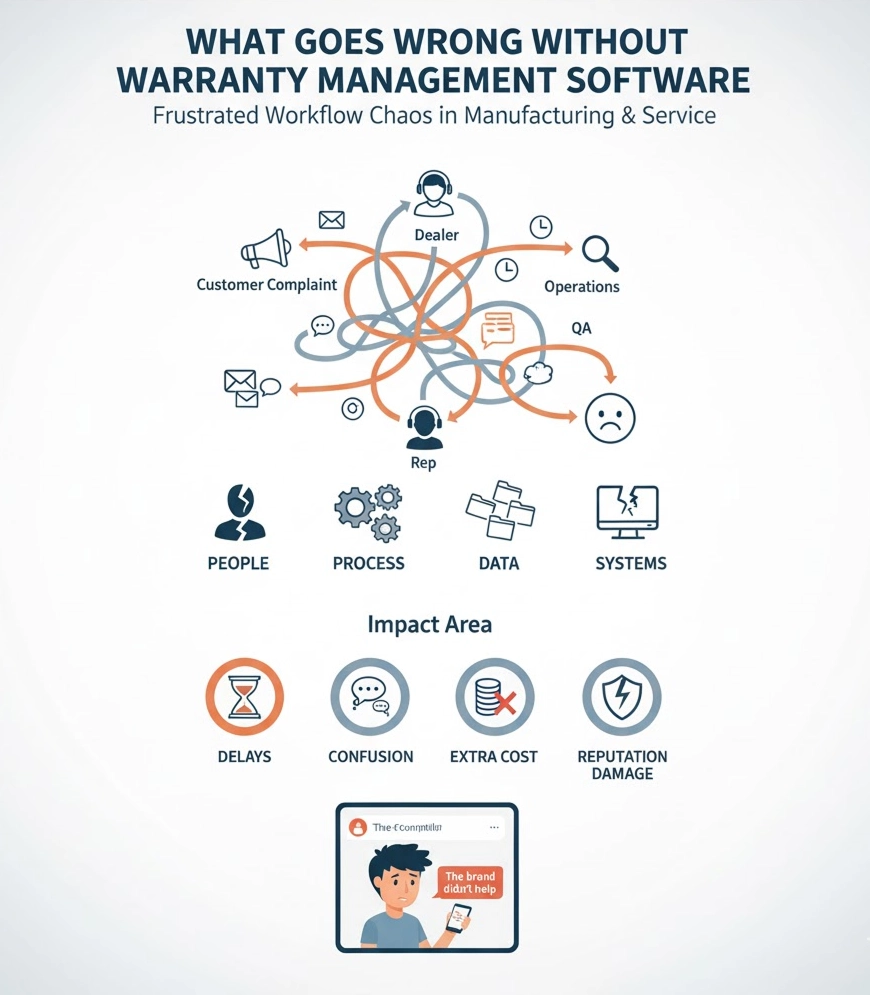
Manufacturers rarely fail for lack of effort. They fail because well-meaning teams are trapped inside brittle processes. Email is invisible to the customer, spreadsheets fall out of sync, and every exception becomes a new rule nobody remembers. A retailer forwards a complaint to a dealer; the dealer phones a rep; the rep pings operations; operations asks QA for photos; QA requests a serial; the customer resubmits the invoice; and twelve days later everyone is frustrated. The customer’s story on social media is simple—“the brand didn’t help”—while your internal audit file is a thicket of email chains and partial data.
When support is manual, four failure modes reinforce one another. People improvise because they must. Processes mutate without documentation. Data is scattered across attachments and private drives. Generic systems record conversations but don’t enforce entitlement rules or RMAs. The result is predictable: slow claim turnaround times, inconsistent policy application, avoidable freight and field costs, and a reputation for being hard to deal with—especially when the product itself is fine.
How Customers Experience the Gap
The harshest reality is at the front line. A customer who paid for a premium appliance or a high-grade laminate wants two things—certainty and speed. They don’t care whether the dealer, distributor, or OEM is technically responsible. If status is unclear, they assume the worst: that the brand is avoiding them. When the process is invisible, even good decisions feel unfair. Your next marketing campaign fights this memory—and it’s a battle unnecessarily lost.
How the Pain Shows Up on the P&L and the Shop Floor
Margin, Cash Flow, Throughput, Brand, Inventory, and Compliance
Warranty is a financial process as much as a service process. If your system can’t prove entitlement and contain costs with evidence, the P&L bleeds quietly. Approvals granted without documentation become the norm; goodwill discounts morph into policy. Freight and field visits multiply because the first interaction didn’t capture what was needed. Parts sit in limbo waiting for a decision, so spares planning chases ghosts. Finance struggles to issue credit notes on time, and supplier recovery happens months too late to matter.
- Margin leakage: approvals without evidence, needless replacements, and missed supplier recovery.
- Cash flow drag: unclosed RMAs, slow credit notes, repeat site visits, and long back-and-forth cycles.
- Throughput loss: queues swell, first-time-right suffers, and managers firefight escalations.
- Brand risk: low transparency looks like indifference; NPS falls even when resolution is fair.
- Inventory distortion: reserved parts and returns without closure complicate MRP and spares planning.
- Compliance exposure: weak audit trails turn routine claims into disputes.
What a Modern Warranty & Support System Looks Like
From Registration to Recovery—The Core Workflow
The simplest path to reliability is designing for the handoff. Every handoff needs just enough data, a clear next owner, and a clock. In a well-implemented warranty management software for manufacturing, registration pins a product’s serial or lot to a specific customer and install date. Entitlement rules check coverage in milliseconds. Claim intake collects evidence the first time. Triage either auto-approves standard cases or routes exceptions to the correct approver with SLA timers. If replacement or return is required, an RMA is generated, logistics are triggered, and labels are issued. Finally, the evidence package attaches to supplier recovery, and analytics summarize trends by SKU, lot, geography, and partner.
- Registration: QR code on packaging or product; quick mobile form binds serial/lot to customer and install context.
- Entitlement: Policy engine checks term, parts/labour coverage, exclusions, and channel validity.
- Claim Intake: Guided form captures photos, short videos, and fault codes; mandatory fields prevent ambiguity.
- Triage & Decision: Auto-approval for low-risk scenarios; exception routing with SLA timers for human review.
- RMA & Logistics: Pick/pack/ship tasks generated with labels; courier tracking attached to the claim.
- Supplier Recovery: Costs mapped to vendor contracts with evidence bundle ready on closure.
- Analytics & Feedback: Defect codes feed QA/R&D; weekly review closes the loop.
Role-Based Views That Keep Everyone Honest
Different users need different truths in the same system. A customer needs reassurance and a clear next step. A dealer needs a prioritized queue, entitlement visibility, and the ability to upload clean documentation without rework. OEM approvers need a worklist with timers, clear policy references, and instant access to the evidence. QA needs defect trendlines. Finance wants cost-to-close and recovery forecasts.
- Customer portal: status, required actions, digital warranty card, knowledge base, and appointment scheduling.
- Dealer/service portal: job queue, entitlement at a glance, documentation capture, parts ordering, and SLA timers.
- OEM consoles: policy configuration, approval workflows, fraud alerts, RMA orchestration, recovery tracking, and dashboards for ops, QA, and finance.
Automation Deep-Dive: How It Actually Works
Entitlement Validation, Claim Automation, RMA, and Supplier Recovery
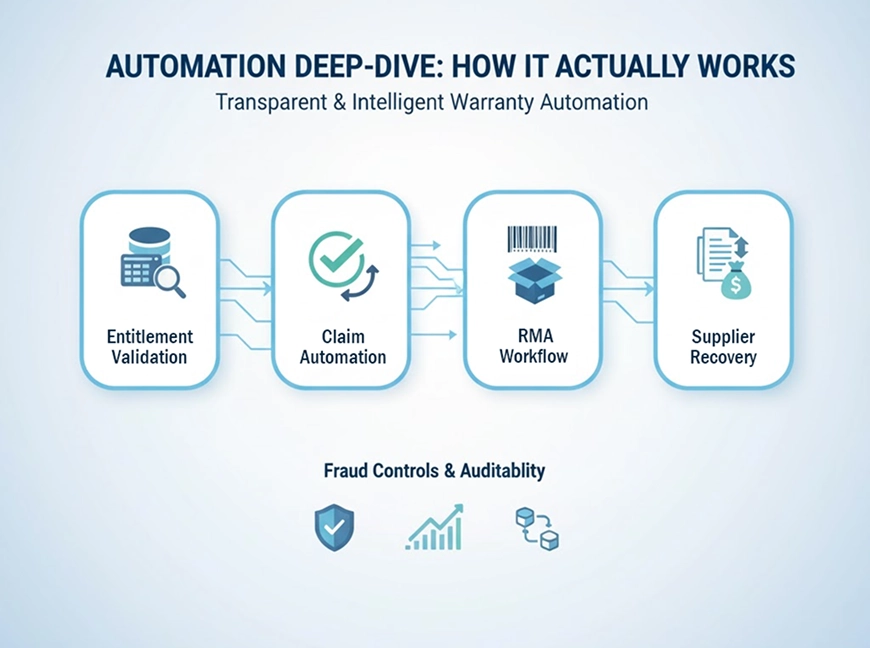
Automation is not a black box; it is codified common sense. The art lies in deciding what the system should approve automatically and what it should escalate. For example, a replacement gasket under ninety days with clean documentation can auto-approve; a compressor failure after two years routes to a senior approver with diagnostic steps. RMAs trigger logistics tasks instantly, with barcode scanning enforcing accuracy during pick/pack/ship. Supplier recovery piggybacks on the same evidence so you recover costs faster and more fairly.
Entitlement validation resolves coverage without human lookups. Claim automation handles standard cases quickly and predictably. RMA orchestration ties the warehouse to service and customer communications. Supplier recovery turns evidence into money in a disciplined, data-backed cadence.
- Entitlement validation: policy matrices resolve eligibility without human lookups.
- Claim automation: low-value, low-risk cases auto-approve; exceptions auto-escalate with checklists.
- RMA workflow: label creation, courier handoff, and status updates are generated within the claim record.
- Supplier recovery: evidence packages (photos, test notes, lot traceability) compile automatically on closure.
Fraud Controls and Auditability That Deter Misuse
Fraud is not common, but it is corrosive when undetected. The best defense is visibility: duplicate serial patterns, abnormal geography flows, repeated claimants, and mismatched proof-of-purchase dates are easy to flag when the data is structured. Immutable logs record who approved what, when, and under which policy version. People behave better when the system makes fairness visible.
- Pattern analytics: alerts for duplicate serials, unusual claim densities, or abnormal timing patterns.
- Device/channel checks (where relevant): ensure claims originate from valid touchpoints.
- Audit trails: policy versioning, approver IDs, timestamps, and status transitions are always visible.
Measurable Outcomes Manufacturers Can Expect
Realistic KPIs and How to Baseline Them
You cannot improve what you do not measure—so begin with baselines. Pull last quarter’s data for claim volume, average TAT (submission to closure), first-time-right percentage, percent of claims with complete evidence on first submission, cost per claim, parts consumption, warranty cost as a percent of revenue, and supplier recovery as a percent of claim cost. Then set weekly improvement targets linked to system behaviors: mandatory evidence fields, auto-approvals for pre-defined scenarios, and SLA timers. Within a few sprints, teams usually report an unmistakable shift: fewer status calls, faster standard resolutions, and cleaner escalations.
In reviews with leadership, focus less on averages and more on distribution. Medians and 90th-percentile TATs reveal whether a small number of stuck cases are dragging perception down. First-time-right per dealer helps prioritize coaching. Recovery per vendor—normalized by claim volume—turns negotiations into data-driven conversations.
- Claim TAT: measure by claim type and by approver group to find bottlenecks.
- First-time-right: track documentation completeness and rework cycles per partner.
- Supplier recovery: compute recovery/% by vendor and fault code; publish monthly league tables.
- Cost per claim: separate parts, freight, on-site service time, and goodwill credits.
- Customer transparency: count status-update calls; they should drop as portal usage rises.
- QA/R&D signal: trend defect codes by SKU, lot, and region; link to engineering actions.
Why Generic Tools Fall Short—And What to Look For Instead
Configurability, Modularity, Integrations, Analytics, Scalability, and TCO
Generic ticketing can log a complaint, but it cannot adjudicate a warranty. Warranty depends on policy nuance, multi-party coordination, and cost attribution. If your system cannot change workflows per region or channel without custom code, the business will work around it; if analytics require exports and manual stitching, managers will manage by anecdotes. The right platform meets you where you are, grows with you, and keeps services overhead under control.
Make a shortlist by running a simple test: can the platform model your current policy without developer help? Can you introduce an auto-approval rule and measure its impact in a week? Can a non-technical admin adjust SLA timers for a single region? If the answers are no, you’re buying services, not software.
- Configurable workflows: steps, approvals, timers, and evidence per product/channel without code heavy lifting.
- Modular architecture: start with Warranty & Support, then add Dealer Portal, WMS, SFA, or LMS as you expand.
- Open integrations: ERP, CRM, WMS/TMS, eCommerce, and mobile apps via APIs/webhooks for clean data flow.
- Role-based analytics: dashboards aligned to decisions, not vanity charts; drill-down to case evidence.
- Scalability & TCO: cloud-native, admin tooling for self-serve changes, predictable pricing.
Implementation in the Indian Context
Data Migration, Change Management, Training, and Time-to-Value
India’s manufacturing channels are heterogeneous: some dealers run modern ERPs; others live on WhatsApp. Your rollout must respect this reality while still raising the bar. Start with the minimum viable integrations—ERP masters for products, dealers, and parts; simple SMS/email notifications; and a lightweight dealer portal. Train with micro-sessions in local languages, focused on the exact tasks each role performs. Publish SLAs and enforce them gently but consistently. Measure adoption weekly and celebrate partners who submit complete, first-time-right documentation.
When cost pressure is high, it is tempting to park analytics for later. Resist that. Operational dashboards are your steering wheel. Without them, you can’t see whether auto-approvals are too lax or whether a particular dealer is dragging averages down. Keep the number of dashboards small but the discipline strong.
- Data migration: import clean masters and active warranties; keep historical archives read-only off-system.
- Change management: define RACI, publish SLAs, align dealer incentives to first-time-right and TAT goals.
- Training: 30–45 minute, role-based walkthroughs with job aids; record quick refresher videos.
- Compliance & audit: standardize evidence capture so disputes are rare and easy to resolve.
- Time-to-value: target one production workflow in 4–6 weeks, then expand to high-volume claim types.
Sector Playbooks: How Warranty & Support Works by Category
Home Appliances
Appliance manufacturers run high volumes of relatively low-value claims with intense brand exposure. Customers expect near-real-time status and simple instructions. The biggest quality-of-life upgrade is standardizing intake: the portal asks for a short video, serial photo, invoice image, and symptom checklist. A rules engine approves simple part replacements immediately, issues an RMA, and triggers label creation. For serviceable failures, the system offers a self-scheduling window with the nearest authorized center.
Because appliances often use shared components across models, defect-code analytics reveal cross-model issues quickly. If a thermistor batch creates intermittent faults in mid-range refrigerators, trendlines spike within days rather than months. QA and procurement can intervene with the supplier before the next production run, and the brand avoids a wave of social media complaints that drain trust and call center capacity.
Spare parts logistics matter as much as adjudication. Barcode scanning in the warehouse, coupled with pick guidance, dramatically reduces mispicks. The cost per claim falls not only because fewer technician revisits are required but also because the first dispatch contains the right part, and courier labels are correctly tied to the RMA. Customers perceive the entire journey as transparent because they can track status and know what to expect at each step.
Building Materials: Plywood & Laminates, Composite Panels, Sanitaryware & Ceramic, Bath & Kitchen Fittings, Hardware & Fittings, Paints & Adhesive
Building materials surface a unique challenge: many failures are installation-sensitive. Moisture, substrate preparation, adhesive type, and cure times influence outcomes. A modern warranty and support system turns this ambiguity into structured evidence. During registration, installers document site conditions with geotagged photos and moisture readings. When a claim occurs, the guided intake forces specific surface-condition shots and a short statement describing installation steps.
Entitlement rules consider policy nuances—for instance, coverage might apply if moisture is below a defined threshold and recommended adhesives were used. If conditions are borderline, the system schedules an inspection workflow with a clear SLA and a templated report format to avoid narrative disputes. For brands selling through thousands of retailers, dealer education is crucial. The dealer portal embeds micro-learning: two-minute clips that show how to collect the right evidence. Partners who maintain high first-time-right rates can be rewarded with faster reimbursement or co-op marketing credits, shifting the culture from escalations to excellence.
Automotive & Industrial Equipment, Power Tools & Industrial Equipment
Automotive and industrial equipment involve higher-value components and downtime-sensitive operations. Here, entitlement must reflect service hours, maintenance records, and fault codes pulled from diagnostics. The system supports conditional approvals—authorization contingent on returning the failed part for teardown analysis or uploading a diagnostic trace.
RMAs may be replaced by field-service workflows. A service job is generated with predefined checklists and torque settings. Technicians capture photos and measurements, and the app prevents job closure until all critical steps are complete. Supplier recovery is stricter: costs are mapped to vendor contracts automatically, with evidence packages dispatched within days of closure, not months.
Fast-Moving Consumer Goods(FMCG)
FMCG warranty is different: the sheer customer volume dwarfs claim value. The ideal approach is frictonless registration and near-instant resolution for specific scenarios. A customer can text a code to register or submit a claim; low-risk situations trigger a replacement coupon or dispatch without escalation.
Analytics watch for batch spikes and regional clusters, enabling recall-like responses where justified. Because brand conversation moves fast, proactive messaging that explains resolution steps and timelines preserves goodwill even when issues are widespread.
From Manual to Automatic: A Closer Look at Each Step
1) Warranty Registration (Including QR Code Warranty Registration)
Registration is the foundation of entitlement. QR code warranty registration eliminates transcription errors and kickstarts lifecycle visibility. For mass retail products, the QR is printed on packaging; for industrial equipment, it sits on the nameplate. The scan opens a mobile page prefilled with product attributes; the customer or installer adds purchase date, invoice photo, and a couple of context fields such as installation location or usage profile. If connectivity is poor—as in many construction sites—the app stores locally and syncs later. A good system keeps registration to under one minute and encourages it with small nudges: extended warranty offers, maintenance reminders, or first-service scheduling.
2) Entitlement Validation
Entitlement validation converts policy PDFs into executable logic. The coverage matrix maps SKU families, terms, parts vs. labour rules, exclusions, and special conditions like commercial use or harsh environments. The system evaluates a claim’s metadata—serial/lot, sale date, channel, registered owner, and context—and returns a clear eligible/not-eligible verdict, with reasons. Where the rules are conditional, the result is “eligible pending evidence,” which prompts the portal to collect exactly what’s missing instead of asking for everything under the sun.
3) Claim Intake and Triage
Claim intake should feel like guided self-service. The form adapts to the product and symptom: an induction cooktop asks for error codes and a top-surface photo; a laminate claim requests moisture readings and edge-closeups. The system checks file quality on upload—rejecting unreadable invoices or blurry serial photos—so approvers don’t waste time. Triage groups claims by risk and value. Standard, low-risk cases auto-approve. Edge cases route to specialized queues (e.g., safety-related complaints). Approvers see context in one place: history, prior claims, registration data, and the relevant policy section.
4) RMA and Logistics
RMA orchestration is often the biggest operational booster. As soon as approval happens, the system generates an RMA, reserves inventory, prints courier labels, and updates the customer portal with pickup or drop-off options. Warehouse steps use barcode/RFID to prevent mispicks and to maintain chain-of-custody for returns. When RMAs close, finance receives a clean record for credit notes, and analytics can attribute cost precisely to parts, freight, and labour.
5) Supplier Recovery
Supplier recovery is a quiet profit center. Without automation, recoveries slip because evidence is incomplete or late. With a proper warranty and support system, the evidence bundle is created as part of the claim flow: photos, test notes, diagnostic traces, and lot history attach automatically. Recovery requests go out on a schedule, and vendor dashboards show status and dispute reasons. Over time, the discipline changes vendor behavior: quality issues are surfaced earlier, and negotiations revolve around data rather than anecdotes.
6) Analytics and Continuous Improvement
Analytics are only useful if they drive decisions. Prioritize a handful of dashboards aligned to weekly rituals: the operations stand-up, QA’s defect review, and finance’s cost tracking. Look for trendlines by SKU and lot, league tables for partners by first-time-right and TAT, and cost-to-close analysis that highlights where coaching or a process fix will yield disproportionate gains. Exporting raw data is fine, but the habit that matters is managers checking one source of truth and acting on it.
Implementation Blueprint: 0–90 Days
Phase 0: Preparation (Week 0–1)
Nominate an internal product owner and define success in a sentence: “Reduce average claim TAT for part replacements from 11 days to 6 days while increasing first-time-right from 62% to 82%.” Collect masters (products, parts, dealers), a sample of recent claim data, and your policy documents. Agree on non-negotiables (SLA timers, mandatory evidence) and on day-one integrations (ERP masters, email/SMS).
Phase 1: Pilot Build (Week 2–4)
Configure the first workflow, usually a high-volume, low-risk claim type. Set up the customer and dealer portals with just the fields you actually need. Implement the entitlement matrix and a small set of auto-approval rules. Prepare quick-reference job aids and 3–4 two-minute training clips per role.
Phase 2: Go Live & Stabilize (Week 5–7)
Launch with a named group of dealers and one internal approver team. Run daily stand-ups for the first week and bi-weekly thereafter. Watch the dashboards: TAT, first-time-right, escalations, and parts mispicks. Fix the top three sources of rework immediately—often poor photo quality, missing invoices, or unclear policy language.
Phase 3: Expand & Optimize (Week 8–12)
Add the next claim type and bring in more dealers. Turn on supplier recovery automation and start publishing a monthly recovery scoreboard. Introduce inspection workflows where the data suggests they will cut rework. Plan the next integration: eCommerce registration feed, WMS/TMS status updates, or CRM contact sync.
Common Risks and How to Avoid Them
Over-Collecting Evidence
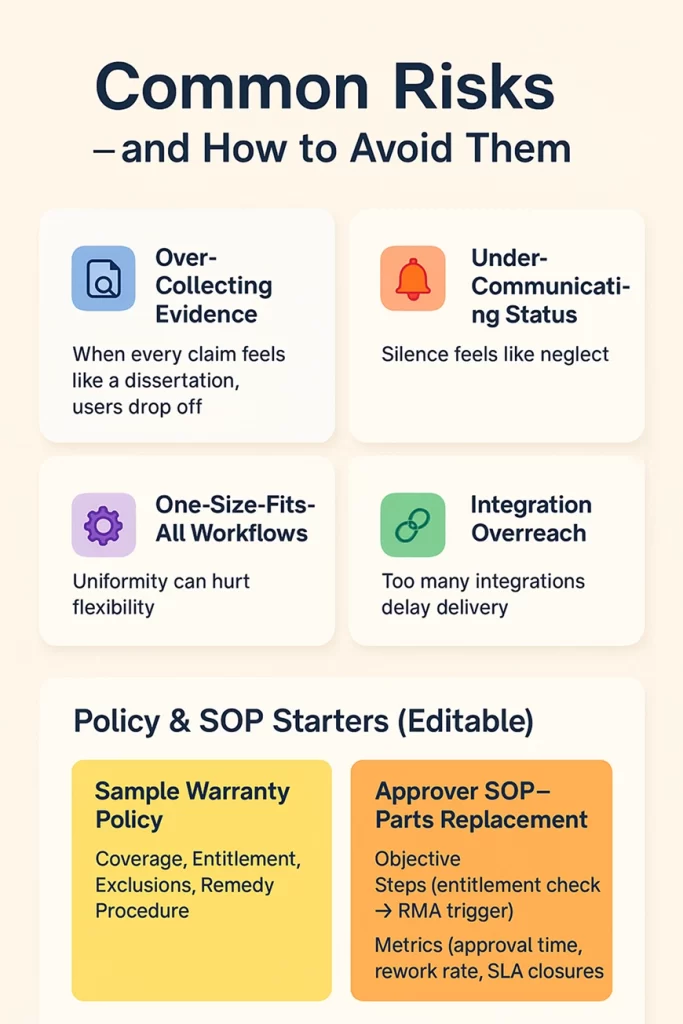
If every claim demands a dissertation, people will bypass the system. Collect only the evidence that changes a decision, and let rules request extra items when risk flags are present. This keeps honest customers moving and focuses human attention on edge cases where judgment matters.
Under-Communicating Status
Silence feels like neglect. Proactive notifications after every status change, plus a portal timeline, reduce status calls and improve perceived fairness—even when outcomes are not in the customer’s favor.
One-Size-Fits-All Workflows
Regions and channels differ. Use configuration, not code forks, to adapt steps and SLAs while keeping analytics comparable. Start with a global template, then override where the business case is clear.
Integration Overreach
Integrate what you must to deliver value. Masters, notifications, and label generation are usually enough for the pilot. Add deeper integrations in phases so you don’t delay the moment of truth: faster, cleaner resolutions.
Policy and SOP Starters (Editable)
Sample Warranty Policy Language
Coverage: The product is warranted against defects in materials and workmanship under normal use for the term specified on its warranty card. Entitlement: Coverage applies to the original purchaser upon registration or valid proof of purchase. Exclusions: Damage due to misuse, incorrect installation, modifications, or environmental factors outside specified operating conditions is excluded. Remedy: At our option, we will repair, replace, or provide an equivalent remedy. Procedure: Customers should submit claims through the portal with serial/lot details, invoice copy, and requested evidence.
Approver SOP (Parts Replacement)
Objective: Approve standard parts replacements consistently within SLA. Steps:
- Verify entitlement auto-check;
- Confirm mandatory evidence;
- Review fault code;
- Approve or route to inspection;
- Ensure RMA/label generation is triggered;
- Add succinct closure note referencing policy clause. Metrics: average approval time, rework rate, and escalations closed within SLA.
Frequently Asked Questions
Isn’t a CRM Case Module Enough?
CRMs are excellent for customer data and sales processes, but warranty adjudication is policy-heavy and logistics-bound. You need entitlement matrices, RMAs, supplier recovery, and audit trails that reflect financial liability. Use CRM for the relationship layer; rely on a warranty & support system to make coverage decisions and move goods.
How Do We Handle Dealers Who Resist Change?
Make the system the easiest way to get paid: faster reimbursements for first-time-right documentation, clear portals, and fewer phone calls. Publish partner scorecards and celebrate the ones who set the standard. Resistance fades when the path of least resistance is also the best experience.
What About Multi-Language Support in India?
Offer portals and notifications in major regional languages. Keep forms concise and use icons to reduce text burden. Provide voice-note options for field technicians where typing is impractical; transcribe on the backend to preserve auditability.
Fix the Real Problem, Build Trust, and Scale Support
A modern warranty and support system for manufacturers turns support from a cost center into a competitive asset. It enforces the right work at the right time with the right evidence, reduces avoidable costs, and makes customers feel looked after—because they are. Start small, measure relentlessly, and scale what works.
Book a focused, 30-minute demo of our Warranty & Support System for the Indian market. We’ll baseline your current claims process, configure a minimal viable workflow, and demonstrate how entitlement checks, claim automation, RMA orchestration, and supplier recovery integrate with your stack. Then decide whether to pilot with a subset of dealers or scale directly.