What is a Warehouse Management System (WMS)? Challenges Manufacturers Face & How EzeOne Solves Them
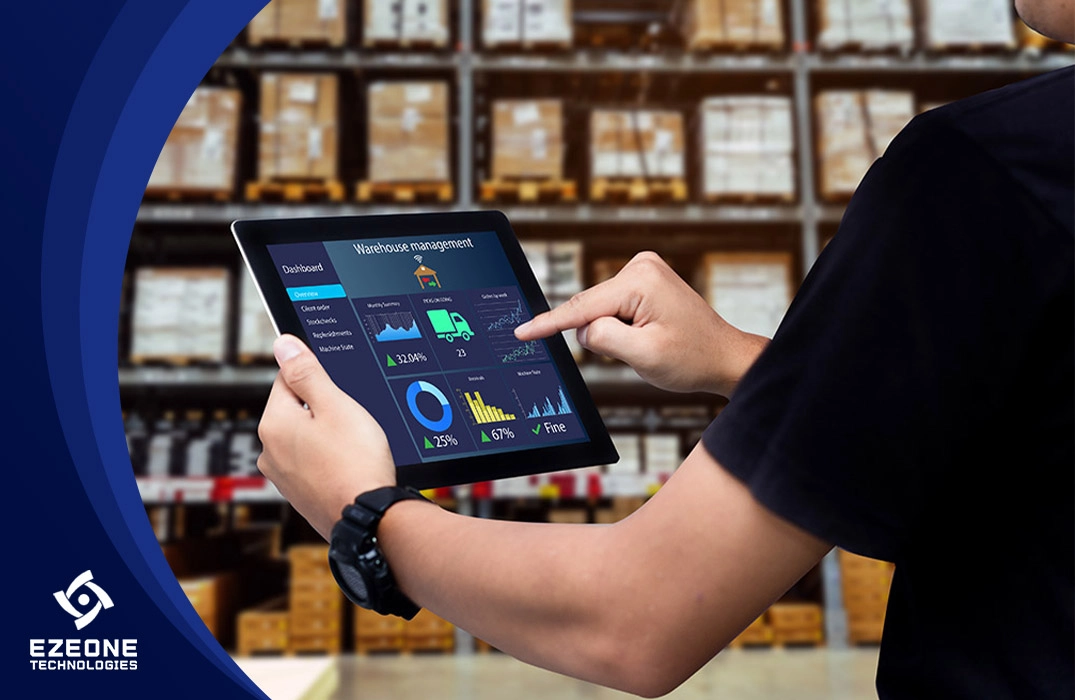
In today’s fast-moving manufacturing world, warehouses aren’t just storage facilities — they’re the heartbeat of the supply chain. Every order shipped on time, every product in the right place, and every satisfied customer starts with good warehouse management. That’s why more businesses are turning to Warehouse Management Systems (WMS) — powerful software that helps track inventory, manage orders, and coordinate dispatch operations with speed and accuracy.
But here’s the truth: many manufacturers still struggle. Delayed shipments, inventory mismatches, wasted storage space, and poor communication between teams are daily headaches. These problems don’t just slow down operations — they cost time, money, and customer trust.
The good news? With the right WMS, these pain points can be solved. A modern, cloud-based platform like EzeOne’s Warehouse Management System brings everything — from inventory control to dispatch management — under one easy-to-use system, making warehouse operations smarter, faster, and more profitable.
In this article, we’ll break down what a WMS is, the common challenges manufacturers face, and how EzeOne helps solve them — in simple terms that anyone can understand.
What is a Warehouse Management System (WMS)?
A Warehouse Management System is specialized software that helps manage day-to-day warehouse activities. It acts as the central brain of warehouse operations, covering tasks like:
- Tracking incoming and outgoing goods
- Managing stock levels in real time
- Organizing product locations in the warehouse
- Picking, packing, and shipping orders
- Handling returns and damaged goods
- Coordinating dispatch management to ensure timely deliveries
Think of it as a GPS for your warehouse. Just as a GPS tells you exactly where you are and the best route to reach your destination, a WMS shows you where every item is stored and the fastest way to get it to the customer.
A good WMS integrates with other systems like ERP (Enterprise Resource Planning), CRM (Customer Relationship Management), and TMS (Transport Management System) to create a smooth flow of information across the entire business.
Common Challenges Manufacturers Face Without an Effective WMS
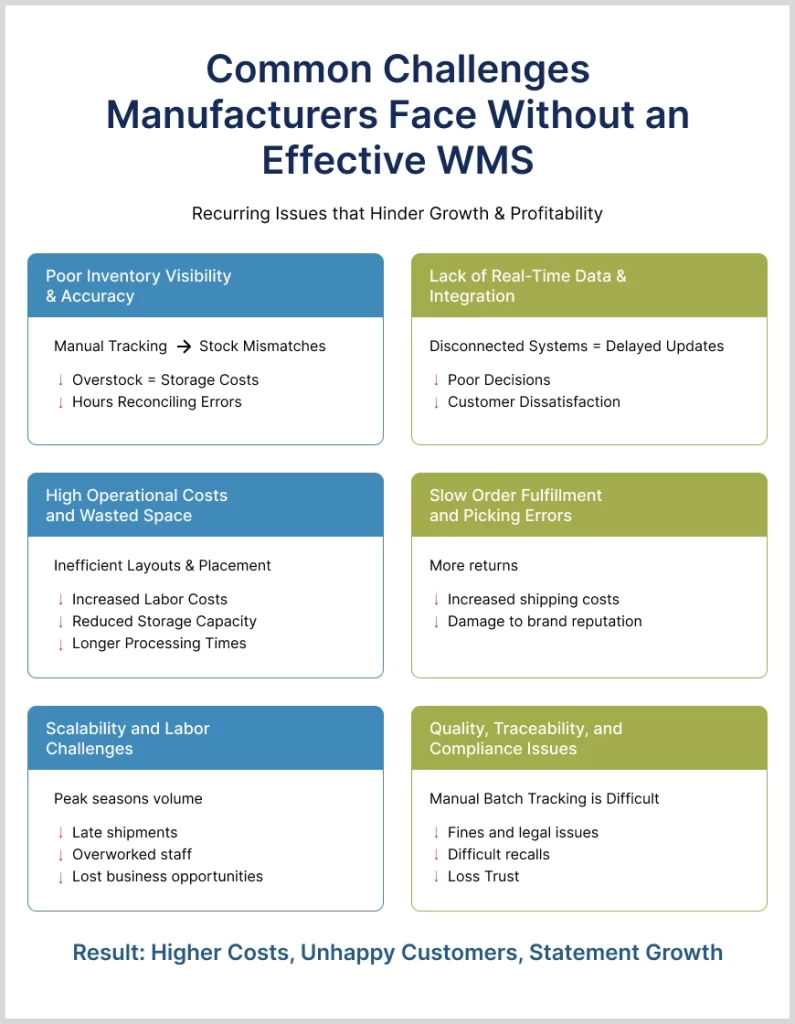
Poor Inventory Visibility and Accuracy
The problem: Many manufacturers still rely on manual counting or outdated spreadsheets to track inventory. This often leads to stock mismatches — either too much stock sitting idle (tying up money) or not enough to meet demand (causing delays).
Impact:
- Stockouts lead to lost sales.
- Overstock increases storage costs.
- Managers spend hours reconciling errors.
Lack of Real-Time Data and Integration
The problem: When different teams (sales, warehouse, procurement) use separate systems that don’t talk to each other, updates are delayed. For example, the sales team might confirm an order without knowing the warehouse is out of stock.
Impact:
- Delays in fulfilling orders.
- Poor decision-making due to outdated information.
- Customer dissatisfaction.
High Operational Costs and Wasted Space
The problem: Inefficient warehouse layouts and poor product placement mean workers travel longer distances to pick items, wasting time and labor.
Impact:
- Increased labor costs.
- Reduced storage capacity.
- Longer order processing times.
Slow Order Fulfillment and Picking Errors
The problem: Manual picking lists or unclear instructions often lead to wrong items being shipped or orders taking too long to process.
Impact:
- More returns due to errors.
- Increased shipping costs for replacements.
- Damage to brand reputation.
Scalability and Labor Challenges
The problem: During peak seasons, order volumes can double or triple. Without a scalable system, the warehouse team becomes overwhelmed.
Impact:
- Late shipments.
- Overworked staff.
- Lost business opportunities.
Quality, Traceability, and Compliance Issues
The problem: In industries like food, pharmaceuticals, or electronics, tracking product batches and expiry dates is essential. Without automated traceability, compliance with industry regulations becomes difficult.
Impact:
- Risk of fines and legal issues.
- Trouble managing recalls efficiently.
- Loss of customer trust.
How a Modern WMS Solves These Pain Points
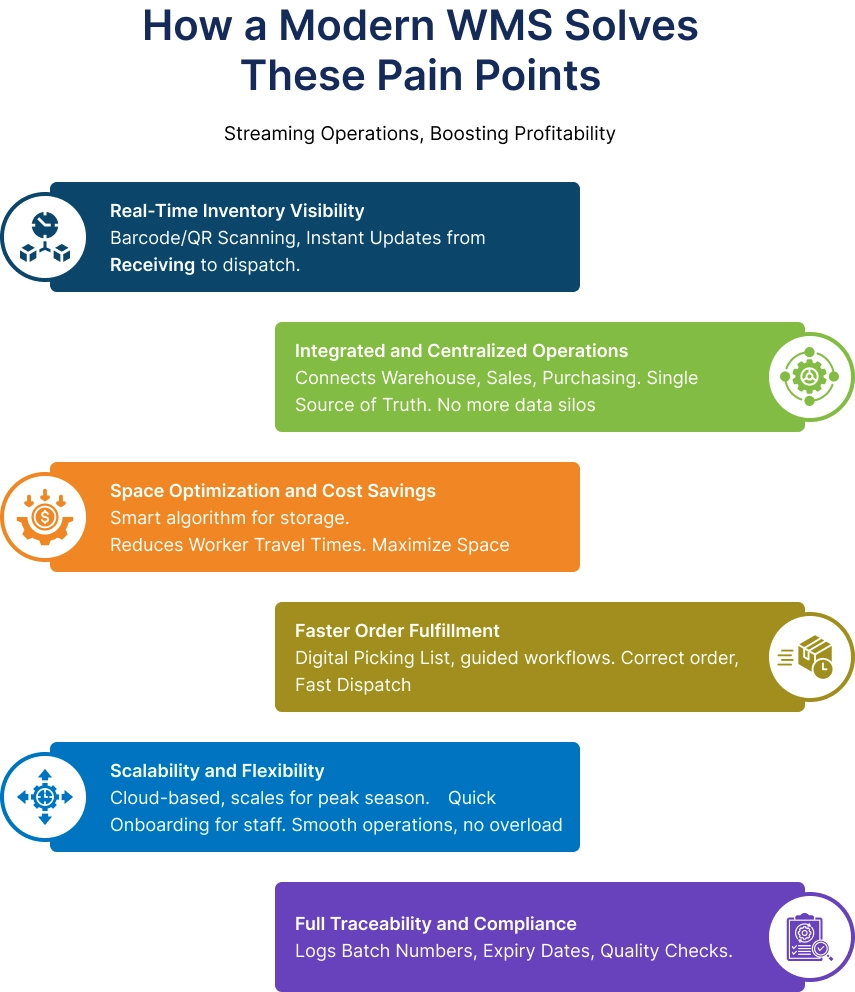
Real-Time Inventory Visibility
With barcode or QR code scanning, every movement — from receiving goods to dispatch — is instantly updated in the system.
- Benefit: Reduces errors, keeps stock levels accurate, and ensures the sales team always knows what’s available.
Integrated and Centralized Operations
EzeOne’s WMS connects warehouse data with sales, purchasing, and dispatch management, creating a single source of truth.
- Benefit: No more double entry or manual syncing. Everyone has access to the same, up-to-date information.
Space Optimization and Cost Savings
Using smart algorithms, a WMS suggests the best storage locations for items based on size, demand, and frequency of picking.
- Benefit: Shorter travel times for workers, more efficient use of warehouse space, and reduced operational costs.
Faster Order Fulfillment and Reduced Picking Errors
Digital picking lists, guided workflows, and dispatch management integration ensure that orders are picked quickly and correctly the first time.
- Benefit: Happier customers, fewer returns, and better brand reputation.
Scalability and Flexibility
EzeOne’s cloud-based WMS scales easily during busy seasons. You can add temporary staff and give them quick access without long training sessions.
- Benefit: Smooth peak season operations without overloading your team.
Full Traceability and Compliance
Each product movement is logged, including batch numbers, expiry dates, and quality checks.
- Benefit: Easy recall management, industry compliance, and improved customer trust.
Why EzeOne’s WMS Stands Out
Unlike generic warehouse solutions, EzeOne’s Warehouse Management System is designed specifically for manufacturers and distributors. Here’s how we help:
- Industry-Specific Workflows: From dealer networks to field-to-factory dispatch, we understand your operations.
- QR/Barcode Integration: Ensures 100% tracking accuracy.
- Real-Time Dashboards: Monitor stock, orders, and dispatch in one place.
- Easy Adoption: Minimal training required — your team can start using it in days.
- Secure Cloud Infrastructure: Data is encrypted and backed up automatically.
- Dispatch Management Built-In: Coordinate deliveries efficiently, track shipments, and optimize routes.
Managing a warehouse without a powerful WMS is like trying to run a factory without a production plan — inefficient and costly. From inaccurate inventory to delayed dispatches, the challenges are real, but so are the solutions.
EzeOne’s Warehouse Management System doesn’t just organize your inventory — it transforms your warehouse into a profit center. With real-time tracking, optimized space usage, error-free order fulfillment, and built-in dispatch management, you can deliver faster, cut costs, and scale with confidence.
Ready to transform your warehouse operations?
Book a Free Demo with EzeOne Today and see how our WMS can make your business more efficient, accurate, and profitable.