Why E-commerce Projects (Website/Online Store) Fail

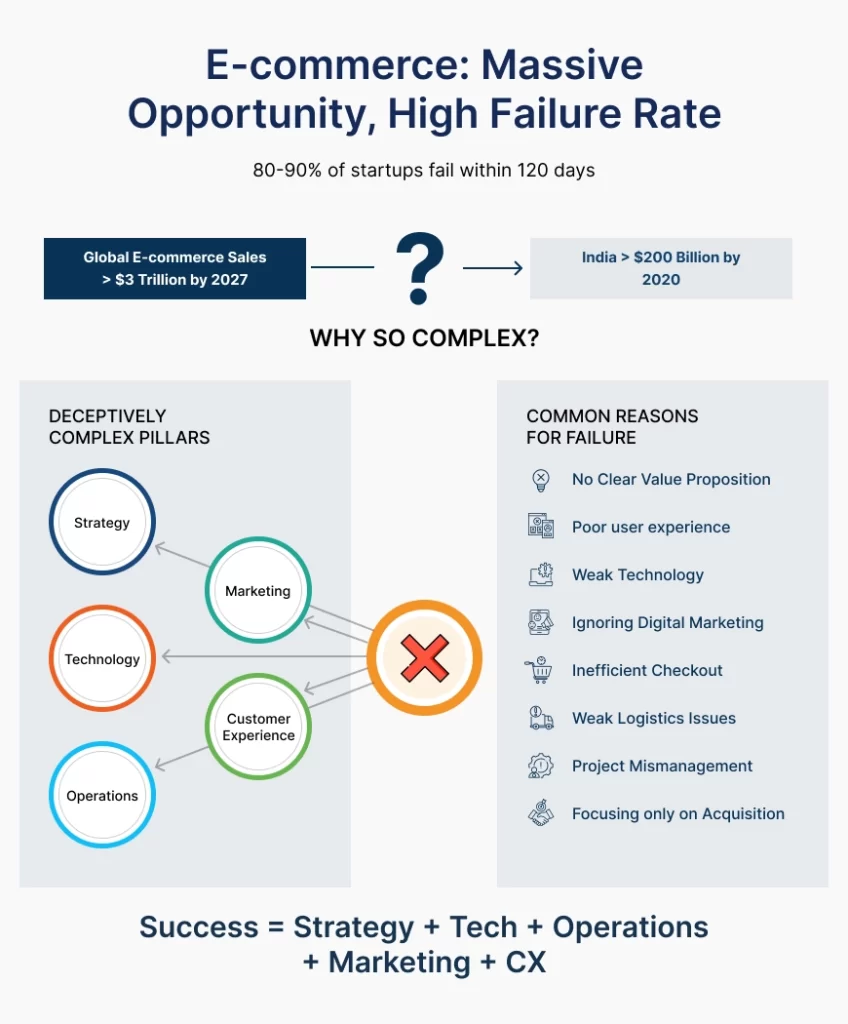
E-commerce has transformed the way we buy and sell. From daily essentials to luxury goods, consumers now expect to shop online with just a few clicks. According to eMarketer, global e-commerce sales are projected to surpass $8 trillion by 2027, while India alone is expected to cross $200 billion by 2030 driven by internet penetration, digital payments, and smartphone adoption. The opportunity is massive — and yet, success in e-commerce is far from guaranteed.
Despite the growth of the industry, research consistently shows that 80–90% of e-commerce startups fail. Even large, well-funded ventures have collapsed due to poor execution. A study by Comma Consulting revealed that nearly 90% of e-commerce startups shut down within 120 days of launch, mostly because they didn’t anticipate the challenges of customer acquisition, user experience, logistics, and technology.
Why is the failure rate so high?
The answer lies in the fact that e-commerce is deceptively complex. On the surface, it may look like building an online store is straightforward — choose a platform, upload products, and start selling. In reality, success requires a delicate balance of strategy, technology, operations, marketing, and customer experience. If any of these pillars are weak, the entire project collapses.
Common reasons for failure include:
- No clear value proposition or differentiation from competitors.
- Poor user experience, leading to high bounce rates and abandoned carts.
- Weak or outdated technology that can’t scale or secure customer data.
- Poor product data and catalog management.
- Ignoring SEO and digital marketing best practices.
- Inefficient checkout, limited payment options, and unclear return policies.
- Lack of robust operations and logistics to fulfill promises.
- Compliance issues with data privacy or payments.
- Project mismanagement, scope creep, and lack of ownership.
- Focusing only on acquisition while ignoring retention and loyalty.
The good news? These failures are preventable. By learning from failed projects, businesses can avoid common pitfalls and increase their chances of building a successful online store.
In this long-form blog, we’ll break down the most common reasons e-commerce projects fail, organized into strategic, technical, operational, and marketing categories. We’ll also highlight best practices and practical solutions so you can build a site that not only launches successfully but thrives for the long term.
Finally, we’ll share a real-world case study: how an e-commerce project built on React (frontend), Node.js (backend), and a modern database launched smoothly, processed secure orders from day one, and delivered strong performance and customer experience.
This isn’t just another list of mistakes — it’s a comprehensive blueprint for success. If you’re building or scaling an e-commerce store, these insights will help you ensure your project doesn’t end up in the failure statistics, but instead becomes part of the success story driving global digital commerce.
Strategic Failures: Building on a Weak Foundation
Behind almost every failed e-commerce project is a strategic misstep. Businesses often rush into execution — building a website, buying ads, uploading products — without laying the right foundation. As a result, even before the first customer arrives, the project is already set up to fail. Let’s examine the most common strategic pitfalls.
Lack of a Clear Value Proposition
The e-commerce market is crowded. Amazon, Flipkart, Myntra, and hundreds of niche stores already compete for customer attention. If your store doesn’t clearly communicate why it’s different, it becomes invisible.
A value proposition is not just about low prices. It could be:
- Convenience (faster delivery, simplified checkout).
- Product uniqueness (exclusive designs, eco-friendly options).
- Superior service (better return policies, personal support).
- Trust (authenticity guarantees, verified suppliers).
Example: Many D2C fashion brands fail because they simply offer generic products at similar price points as established players. Without differentiation, customers stick to familiar names. In contrast, brands like Bewakoof succeeded by offering quirky, localized designs with strong brand identity, giving buyers a reason to choose them.
Takeaway: If you can’t articulate your “why us” in one sentence, customers won’t choose you.
Weak Market Validation
Another major mistake is assuming that offline demand or competitor success will automatically translate online. Businesses often skip testing and launch into full development, spending lakhs of rupees on a website before confirming if people even want the product.
Example: A startup selling premium organic snacks failed after six months online because they assumed demand existed. However, they discovered too late that customers weren’t willing to pay 2–3x the price of regular snacks. Proper validation through small-scale pilots or surveys could have saved time and money.
Solution: Before building, validate your market. Run small ad campaigns to gauge interest. Use landing pages and sign-up forms to measure demand. Talk to potential customers. A few thousand rupees spent on validation can prevent lakhs wasted on a doomed project.
Platform Misfit
Choosing the wrong e-commerce platform is another frequent killer.
- A small startup may over-engineer with expensive headless commerce or Magento when Shopify or WooCommerce would suffice.
- Conversely, scaling enterprises may stick with basic SaaS solutions that lack customization, leading to bottlenecks.
- Some projects fail because they underestimate the importance of integrations with ERP, CRM, or warehouse systems.
Case: A mid-sized electronics brand invested in a custom-built platform with microservices. It looked impressive but cost huge sums to maintain and slowed down releases. Meanwhile, competitors on Shopify scaled faster with lower overhead.
Solution: Match your platform to your stage and scalability goals. For early-stage startups, prioritize simplicity and speed-to-market. For scaling brands, choose systems that integrate with enterprise tools and can handle high traffic without breaking.
Misalignment Among Stakeholders
E-commerce projects are rarely run by one person. They involve founders, marketing teams, developers, operations, and sometimes external agencies. If these groups don’t share the same goals, projects collapse.
- Marketing wants fast launches to test campaigns.
- Developers prioritize clean code and scalability.
- Operations need stability and integration with supply chains.
- Finance pushes for cost control.
When these priorities clash without resolution, the result is scope creep, missed deadlines, and wasted resources.
Example: A home appliances brand delayed its online store launch for six months because the leadership team couldn’t agree whether to prioritize mobile UX improvements or ERP integration. By the time they launched, competitors had already captured the market.
Solution: Establish governance early. Use a RACI model (Responsible, Accountable, Consulted, Informed) to define roles. Hold alignment workshops before development starts. Maintain a shared roadmap where all stakeholders can track progress and trade-offs.
Unrealistic Growth Expectations
A subtler but equally dangerous mistake is unrealistic forecasting. Many founders expect overnight success, assuming traffic and sales will skyrocket after launch. When results don’t meet inflated expectations, budgets dry up, morale dips, and the project is abandoned.
Reality check: E-commerce is a marathon, not a sprint. Building traffic organically takes months of SEO and content investment. Paid campaigns need testing and optimization. Customer trust grows slowly.
Solution: Set realistic KPIs for the first year. Aim for gradual growth with focus on retention, not just acquisition. Allocate budgets for ongoing marketing and operations, not just launch.
Key Takeaway: Strategy First, Technology Later
The biggest reason e-commerce projects fail is not poor technology but poor strategy. Without a clear value proposition, validated demand, the right platform, aligned stakeholders, and realistic goals, even the most advanced website will collapse.
A strong strategy ensures your store is not just another digital shop but a sustainable business with clear differentiation, customer focus, and growth potential.
Product & UX Failures: When Customers Leave Before Buying
A visitor comes to your e-commerce site with intent. They’re ready to browse, compare, and possibly buy. But within a few seconds, they bounce — never to return. What went wrong?
In most cases, the issue is user experience (UX). Studies show that 88% of online shoppers won’t return to a site after a bad experience, and poor UX is one of the top reasons behind high cart abandonment rates (averaging 70% globally). Let’s explore the common UX-related pitfalls.
Poor Information Architecture
Customers must be able to find products quickly. Yet many e-commerce sites suffer from confusing navigation, irrelevant categories, or broken filters.
- Problem: A customer looking for “men’s sports shoes” gets shown leather formals.
- Impact: Frustration leads to higher bounce rates and lost sales.
Solution:
- Build categories and subcategories based on how customers shop, not how warehouses stock.
- Use customer-centric terms (e.g., “Running Shoes” instead of “Athletic Footwear”).
- Test navigation through usability studies before launch.
Checkout Friction
Cart abandonment is the graveyard of e-commerce dreams. According to Baymard Institute, the average cart abandonment rate is 69.8%. The reasons? Long forms, forced account creation, hidden shipping fees, and slow payment processing.
Example: A furniture brand reported that 40% of customers dropped off during checkout. Why? The form required unnecessary details like secondary phone numbers and PAN card information before allowing purchase.
Solution:
- Keep checkout short — ideally one page.
- Offer guest checkout.
- Display shipping costs upfront.
- Auto-fill form fields where possible.
Mobile Neglect
More than 58% of global e-commerce sales come from mobile devices. Yet many stores still design for desktop first, leaving mobile users struggling with tiny buttons, zooming, or slow load times.
Impact: Poor mobile UX directly reduces conversions, especially in countries like India where mobile dominates internet usage.
Solution:
- Design mobile-first, not desktop-first.
- Optimize for Core Web Vitals like LCP (Largest Contentful Paint) and CLS (Cumulative Layout Shift).
- Test across multiple devices and operating systems.
Slow Load Times
Every second counts in e-commerce. Research shows that a 1-second delay in page load reduces conversions by 7%. Many projects ignore performance optimization, leading to slow product pages and abandoned carts.
Solution: Compress images, use lazy loading, implement caching, and serve assets via a CDN.
Lack of Accessibility & Trust Signals
Accessibility is not optional. Sites that don’t follow accessibility guidelines (like WCAG) shut out entire customer groups. At the same time, failure to display trust signals — SSL, secure checkout badges, reviews, and testimonials — creates doubt in buyers’ minds.
Solution:
- Ensure screen reader compatibility, proper contrast, and keyboard navigation.
- Show SSL certificates, trust badges, and authentic customer reviews.
- Add detailed product descriptions with dimensions, materials, and clear photos.
Key Takeaway
UX failures are silent killers. Customers won’t complain — they’ll just leave. Investing in usability, mobile-first design, fast checkout, and trust-building features ensures visitors stay, engage, and convert.
Technology & Architecture Failures: Weak Foundations that Collapse Under Pressure
While UX impacts the front-end, technology defines the backbone of your e-commerce site. Many projects fail because they underestimate the importance of a scalable, secure, and well-integrated tech stack.
Over-Engineering vs Under-Engineering
- Over-engineering: Startups adopting complex microservices, custom frameworks, and unnecessary features, making systems expensive and difficult to maintain.
- Under-engineering: Established brands relying on outdated monolithic platforms that can’t handle growth.
Example: A mid-sized fashion retailer built a fully custom solution with 10+ microservices, but maintaining it required a team of 12 developers. Costs ballooned, and releases slowed down. Meanwhile, competitors on Shopify scaled with ease.
Solution: Choose balanced architecture. Start small with scalable SaaS (Shopify, WooCommerce). Scale to headless solutions (React, Node.js, APIs) when traffic and complexity demand it.
Performance & Scalability Issues
During campaigns or festive seasons, traffic spikes can break fragile systems. Sites crash, carts fail, and customers leave permanently.
Case: An electronics brand ran a Diwali sale, expecting 10,000 visitors per hour. Their site couldn’t handle the load, leading to crashes and lost sales worth crores.
Solution:
- Use cloud-based infrastructure that auto-scales.
- Conduct load testing before campaigns.
- Implement CDNs and caching layers.
- Monitor performance metrics continuously.
Integration Failures
E-commerce doesn’t operate in isolation. It must integrate with payment gateways, shipping APIs, ERP systems, CRMs, and marketing tools. Poorly designed integrations create order mismatches, inventory errors, and failed payments.
Example: A sanitaryware brand faced frequent delivery errors because their site wasn’t properly integrated with their 3PL’s tracking system. Customers received incorrect updates, eroding trust.
Solution: Invest in robust APIs and middleware. Test integrations thoroughly before launch. Monitor for failures in real-time.
Security Neglect
Nothing destroys customer trust faster than a data breach. Yet many e-commerce projects ignore basic security. Common lapses include:
- No SSL certificates.
- Weak password policies.
- Storing customer data in plain text.
- Lack of fraud detection.
Impact: Beyond customer loss, businesses face penalties under GDPR, PCI-DSS, or India’s DPDP Act.
Solution:
- Enforce HTTPS across the site.
- Use tokenization for payments.
- Deploy fraud detection tools.
- Run periodic security audits.
Security Neglect
Nothing destroys customer trust faster than a data breach. Yet many e-commerce projects ignore basic security. Common lapses include:
- No SSL certificates.
- Weak password policies.
- Storing customer data in plain text.
- Lack of fraud detection.
Impact: Beyond customer loss, businesses face penalties under GDPR, PCI-DSS, or India’s DPDP Act.
Solution:
- Enforce HTTPS across the site.
- Use tokenization for payments.
- Deploy fraud detection tools.
- Run periodic security audits.
Lack of Observability
Many projects fail because they have no monitoring in place. Without logs, metrics, or alerts, issues go unnoticed until customers complain.
Solution: Implement monitoring tools like New Relic, Datadog, or ELK stacks. Set up alerts for downtime, failed transactions, and unusual traffic.
Key Takeaway
A weak tech stack may not show cracks immediately, but it will collapse under pressure. Success requires balanced architecture, strong integrations, top-notch security, and continuous monitoring.
Data & Catalog + SEO & Content: The Twin Engines of Discoverability and Conversion
A store’s product catalog and its content/SEO strategy are inseparable. One ensures that customers see accurate, compelling information when they land on your site; the other ensures that they actually find your site in the first place. Many e-commerce failures can be traced back to messy catalog management or ignored SEO practices.
Catalog Chaos: Inconsistent Product Data
Your product catalog is the backbone of your online store. If the catalog is incomplete, inconsistent, or inaccurate, customers will simply abandon the site.
- Problem: Missing product descriptions, poor images, and inconsistent attributes (e.g., color listed as “Red” in one SKU and “Crimson” in another).
- Impact: Shoppers can’t compare products or trust information, leading to lower conversions.
Case: A mid-size furniture brand lost customers because dimensions weren’t standardized — one product listed “50x70cm,” another “0.5m x 0.7m.” Confused shoppers abandoned carts.
Solution:
- Create standardized naming conventions and attribute formats.
- Use a Product Information Management (PIM) system for centralized data.
- Regularly audit product listings for consistency and completeness.
Poor Visual Assets
E-commerce is a visual-first industry. Yet many projects fail because product images are low-quality, inconsistent, or missing.
- Problem: Grainy photos, lack of angles, or no lifestyle/context images.
- Impact: Customers can’t visualize the product, especially in categories like fashion or home décor.
Solution: Invest in professional photography. Use 360-degree views, lifestyle imagery, and video demos where possible.
SEO Neglect: Invisible Stores
Search engines drive a huge share of traffic, yet many e-commerce sites ignore SEO fundamentals.
- Crawl traps: Faceted navigation creates duplicate pages without canonical tags.
- Thin content: Category pages with nothing but product grids.
- Missing metadata: Titles, descriptions, and schema often blank or generic.
- Slow site speed: Google penalizes sites with poor Core Web Vitals.
Example: A fashion retailer invested heavily in ads but ignored SEO. Once ad budgets ran out, traffic collapsed, because organic visibility was near zero.
Solution:
- Optimize metadata with targeted keywords.
- Add descriptive, keyword-rich content to category pages.
- Use structured data (schema) for products, reviews, and breadcrumbs.
- Build internal linking strategies to guide crawlers and users.
Content Marketing: Beyond Product Pages
SEO isn’t just technical — it thrives on content. Many failed stores lacked blogs, buying guides, or influencer-driven content, leaving them unable to attract top-of-funnel traffic.
Solution:
- Build content hubs (e.g., “How to Choose the Right Running Shoes”).
- Publish case studies, how-to articles, and product comparisons.
- Leverage influencer collaborations and user-generated content.
Multilingual & Localized SEO
For stores targeting multiple regions, localization is critical. Ignoring local SEO — currencies, languages, taxes — alienates international customers.
Solution:
- Implement hreflang tags for multi-language support.
- Translate product descriptions (not just via Google Translate).
- Optimize for local keywords and cultural nuances.
Key Takeaway
Catalog chaos and SEO neglect make your store invisible and untrustworthy. Clean product data + strong SEO and content strategy = discoverability and conversions.
Checkout, Payments & Trust: The Final Gatekeepers
You’ve won the customer’s attention, they’ve browsed, and they’ve added items to the cart. But at checkout, they disappear. This “last-mile failure” is one of the most common reasons e-commerce projects fail — and also one of the most frustrating, because the buyer was ready to convert.
Limited Payment Options
Today’s shoppers expect flexibility. In India, UPI dominates, while wallets like Paytm, PhonePe, and Google Pay are standard. International buyers expect PayPal, Apple Pay, or Klarna.
Problem: Stores offering only credit card payments alienate large customer segments.
Impact: Lost sales from willing buyers.
Solution:
- Integrate local and global payment options.
- Support EMI, Buy Now Pay Later (BNPL), and COD where relevant.
Hidden Costs and Surprise Fees
One of the top reasons for cart abandonment is hidden costs — shipping fees, taxes, or handling charges that appear only at the final step.
Case: A cosmetics brand showed free shipping on product pages but added ₹199 fees at checkout. Abandonment skyrocketed.
Solution: Show total costs upfront. Be transparent about delivery fees, taxes, and return policies.
Unclear Returns and Refund Policies
Trust is everything in e-commerce. If buyers don’t see clear policies on returns, warranties, or refunds, they hesitate.
Solution: Display return and refund policies prominently. Keep them customer-friendly (e.g., “30-day free returns”).
Lack of Trust Signals
Even small details affect trust:
- Missing SSL certificates.
- No secure checkout badges.
- Few or no customer reviews.
Solution:
- Always enforce HTTPS.
- Add visible trust badges during checkout.
- Collect and display authentic reviews and testimonials.
Checkout Usability
Long forms, forced account creation, or buggy coupon codes frustrate buyers.
Solution:
- Allow guest checkout.
- Auto-fill addresses.
- Minimize form fields.
- Test coupons and promotions thoroughly.
Key Takeaway
Checkout and payments are the final hurdle. If customers lose trust or face friction here, all your effort in attracting them goes to waste. Prioritize payment diversity, transparency, trust-building, and usability to maximize conversions.
Analytics, KPIs & Operations: Flying Blind and Breaking Promises
E-commerce is a data-driven business. Every click, view, and purchase generates insights. Yet many projects fail because they either don’t track the right data or don’t act on it. Similarly, operations — the “backstage” of e-commerce — often determine whether customers receive what was promised. Weak analytics combined with poor operations is a recipe for failure.
No Defined KPIs
Many e-commerce projects measure “vanity metrics” like website visits or social followers while ignoring the numbers that really matter:
- Conversion Rate (CR): How many visitors actually buy.
- Average Order Value (AOV): How much customers spend per purchase.
- Customer Acquisition Cost (CAC): How much you spend to acquire one customer.
- Customer Lifetime Value (CLV/LTV): How much profit a customer brings over time.
Problem: A store celebrating “10,000 visitors this month” but with a conversion rate of 0.2% isn’t succeeding — it’s leaking money.
Solution: Define KPIs aligned with business goals. Monitor them regularly and tie team incentives to improvements in CR, AOV, and LTV.
Lack of Analytics Infrastructure
Some sites launch without proper tracking systems. They have no event tracking, no funnel analysis, and no heatmaps. As a result, they don’t know:
- Where customers drop off.
- Which products are popular.
- Which campaigns bring sales versus wasted clicks.
Solution:
- Use tools like Google Analytics 4, Mixpanel, or Amplitude for tracking.
- Install heatmap tools like Hotjar or Microsoft Clarity to study user behavior.
- Build dashboards for real-time visibility.
No Experimentation Culture
E-commerce thrives on continuous optimization. Successful stores constantly test:
- Different checkout layouts.
- Product descriptions.
- Pricing and discounts.
- Marketing creatives.
Failed stores rely on assumptions. They never A/B test, so they never learn what actually works.
Solution: Make experimentation part of culture. Run small, controlled A/B tests every week. Document results and scale what works.
Operations Failures: The Silent Killer
Even with perfect analytics, poor operations ruin the customer experience. Many e-commerce failures stem from the inability to deliver orders reliably.
- Stock inaccuracies: Selling items that aren’t in stock leads to canceled orders.
- Slow fulfillment: Customers expect fast shipping. If competitors deliver in 2 days and you take 7, you lose loyalty.
- High RTO (Return to Origin): Common in India, where COD orders get rejected due to poor address verification or lack of delivery communication.
- Reverse logistics chaos: No proper system for handling returns, refunds, or exchanges.
Example: An FMCG brand launched an online store but didn’t sync inventory with warehouses. Customers frequently ordered out-of-stock products, leading to mass cancellations and bad reviews. Within six months, the store shut down.
Solution:
- Integrate your store with an OMS/WMS (Order/Warehouse Management System).
- Use address verification to reduce RTO.
- Partner with reliable 3PLs (third-party logistics providers).
- Establish clear SLAs for fulfillment and returns.
Lack of Post-Sale Analytics
E-commerce doesn’t end at the sale. Tracking delivery times, return rates, and customer satisfaction is essential. Many failed stores don’t monitor these, so they never see where operations break down.
Solution: Measure Net Promoter Score (NPS), return reasons, and delivery satisfaction. Feed insights back into operations for continuous improvement.
Key Takeaway
Without analytics, you’re flying blind. Without strong operations, you’re breaking promises. Together, they account for a huge share of e-commerce failures. To succeed, define KPIs, build analytics infrastructure, create an experimentation culture, and ensure your operations can reliably deliver on your brand promise.
Compliance & Legal: The Overlooked Risk That Can Sink You
Many e-commerce founders think compliance is a boring legal formality. In reality, it’s a survival issue. Non-compliance can lead to fines, lawsuits, blocked payments, or even site shutdowns. Customers, too, are increasingly sensitive to privacy and trust. A single lapse can undo years of effort.
Data Privacy Laws (GDPR, DPDP, CCPA)
- In Europe, the GDPR requires explicit consent for collecting and processing personal data.
- In India, the new DPDP Act (Digital Personal Data Protection) enforces strict rules on how businesses collect, store, and share data.
- In California, CCPA gives users the right to opt out of data sales.
Failure Example: A global retailer was fined millions under GDPR for collecting email addresses without explicit opt-in.
Solution: Implement consent banners, allow opt-outs, and store consent records.
PCI-DSS and Payment Compliance
If you process payments, you must follow PCI-DSS standards. This means encrypting card data, using secure gateways, and not storing sensitive payment information improperly.
Solution: Work with certified payment gateways. Tokenize data. Regularly audit systems.
Tax & Invoicing Compliance
E-commerce also means dealing with GST in India, VAT in Europe, or sales tax in the U.S. Many projects fail because they mismanage tax rules, leading to penalties.
Solution: Integrate tax compliance tools into your checkout. Ensure invoices meet regional requirements (like e-invoicing in India).
Consumer Protection Regulations
In markets like India, the Consumer Protection Act requires clear return/refund policies. Hidden terms or unfair conditions can lead to legal action.
Solution: Write transparent policies, get them reviewed legally, and make them visible on your site.
Key Takeaway
Compliance is not optional. From data privacy to payments, taxes, and consumer rights, ignoring regulations can sink your business faster than a slow checkout. Successful e-commerce stores bake compliance into their processes from day one.
Project & People Failures: When Teams and Processes Break Down
E-commerce projects are not just about technology — they are about people, collaboration, and execution. Many ventures collapse not because the idea was bad or the platform was weak, but because the project was poorly managed.
Scope Creep and Lack of Prioritization
One of the most common killers of e-commerce projects is scope creep. Teams start with a clear idea but keep adding features: loyalty programs, influencer dashboards, complex integrations. What was supposed to take 3 months drags on for 12, burning budgets and morale.
Example: A mid-sized apparel brand wanted a simple online store. During development, stakeholders added a marketplace module, a custom ERP, and an influencer platform. Costs tripled, timelines slipped, and by launch, competitors had already captured the space.
Solution:
- Define an MVP (Minimum Viable Product).
- Prioritize core features: catalog, checkout, payments, fulfillment.
- Save “nice-to-haves” for later phases.
Weak Quality Assurance (QA) and Testing
Many e-commerce failures stem from launching without proper QA. Sites go live with broken links, buggy coupon codes, or crashes during checkout. Customers encountering these problems rarely return.
Solution:
- Implement a QA process: functional testing, UAT (User Acceptance Testing), and load testing.
- Create staging environments that mirror production.
- Test not just the site but also integrations with payment gateways, logistics, and CRMs.
No Clear Ownership
In some projects, no one “owns” success. Marketing blames IT, IT blames operations, and vendors blame clients. Without accountability, issues linger unresolved.
Solution: Assign a Product Owner responsible for decisions, prioritization, and results. Ensure every task has a directly accountable person.
Underestimating Post-Launch Needs
Some teams treat launch as the finish line. In reality, it’s the starting point. Without post-launch monitoring, optimization, and customer support, projects decline fast.
Solution:
- Plan a 90-day post-launch roadmap.
- Budget for ongoing maintenance, not just development.
- Train support staff and prepare escalation workflows.
Communication Breakdowns
Cross-functional teams (designers, developers, marketers, logistics) often work in silos, leading to misaligned goals.
Solution: Use agile methods like Scrum or Kanban. Hold sprint reviews and retrospectives. Encourage transparency with tools like Jira, Trello, or Asana.
Key Takeaway
Even the best ideas fail without disciplined project management and strong ownership. Define scope, test rigorously, assign accountability, and plan for the long term.
Marketing & Retention: Focusing Only on Acquisition Is a Death Trap
Many e-commerce projects fail not because they can’t attract customers, but because they can’t keep them. Paid ads may bring visitors, but if retention is ignored, customer acquisition costs (CAC) skyrocket while margins shrink.
Over-Reliance on Paid Acquisition
Many new stores pour money into Google Ads and Facebook campaigns. While this brings traffic, it’s unsustainable. Once ad spend stops, traffic vanishes.
Solution: Balance paid ads with organic growth (SEO, content marketing) and retention strategies.
Weak Lifecycle Marketing
E-commerce is not one-and-done. Successful brands map the customer journey from awareness to loyalty. Failed ones stop after the first sale.
Solution: Implement lifecycle marketing:
- Welcome campaigns for new signups.
- Abandoned cart reminders to recover lost sales.
- Post-purchase follow-ups to build trust.
- Win-back campaigns for inactive customers.
Neglecting Personalization and Segmentation
Sending the same email to all customers doesn’t work. Today’s buyers expect personalized offers based on browsing and purchase history.
Solution:
- Segment customers (new vs repeat, high-value vs discount shoppers).
- Use AI-driven personalization for product recommendations.
Ignoring Loyalty and Referral Programs
Retention is cheaper than acquisition. Yet many stores skip loyalty or referral programs.
Example: A cosmetics startup increased repeat purchases by 40% after launching a simple points-based loyalty program with referral bonuses.
Solution: Launch tiered loyalty programs, influencer tie-ups, and referral incentives to encourage repeat sales.
Not Leveraging Owned Channels
Failing stores rely only on ads and marketplaces. Winning stores build communities via email, WhatsApp, and social media.
Solution:
- Build an email/SMS/WhatsApp subscriber list.
- Share valuable content, not just promotions.
- Create engagement loops (reviews, UGC, contests).
Key Takeaway
Customer acquisition wins attention. Customer retention builds empires. E-commerce projects that invest in lifecycle marketing, personalization, and loyalty create sustainable growth.
Success Snapshot: A Launch That Got It Right
Failures in e-commerce are common, but they’re not inevitable. When projects are executed with the right mix of strategy, technology, and operations, they can succeed from day one. At EzeOne Technologies, we recently helped a client launch an e-commerce platform that illustrates what success looks like.
The client wanted a fast, secure, and scalable store that could serve customers across India. The tech stack was carefully chosen: React for the frontend (delivering fast, responsive user interfaces), Node.js for the backend (lightweight, scalable, and ideal for APIs), and a modern NoSQL database for managing catalog and customer data.
Unlike many rushed launches, the project started with clear validation:
- The team analyzed competitors and identified a gap in service quality.
- Pilot campaigns confirmed real customer demand before full-scale development.
- The value proposition was crystal clear — superior product quality and smoother online experience.
From a user experience perspective, the store was designed mobile-first. Checkout was optimized for simplicity with just a few steps. Payment options included UPI, wallets, credit/debit cards, and COD to cater to Indian preferences.
Operationally, the site integrated with warehouse systems to ensure accurate stock levels. Shipping APIs were tested extensively, and returns management was automated to reduce customer friction.
The results: Within hours of going live, the client started receiving orders. Page load times averaged under 2 seconds. No crashes were reported even during traffic spikes. Customers praised the transparent checkout, clear return policy, and fast confirmation emails.
This launch proves that success is not about big budgets or complex architectures. It’s about aligning business goals with customer needs, using the right technology, and ensuring operations deliver on promises. By avoiding the common pitfalls outlined in this blog, e-commerce businesses can replicate this success story.
Pre-Launch & Post-Launch Playbooks: Your Roadmap to Success
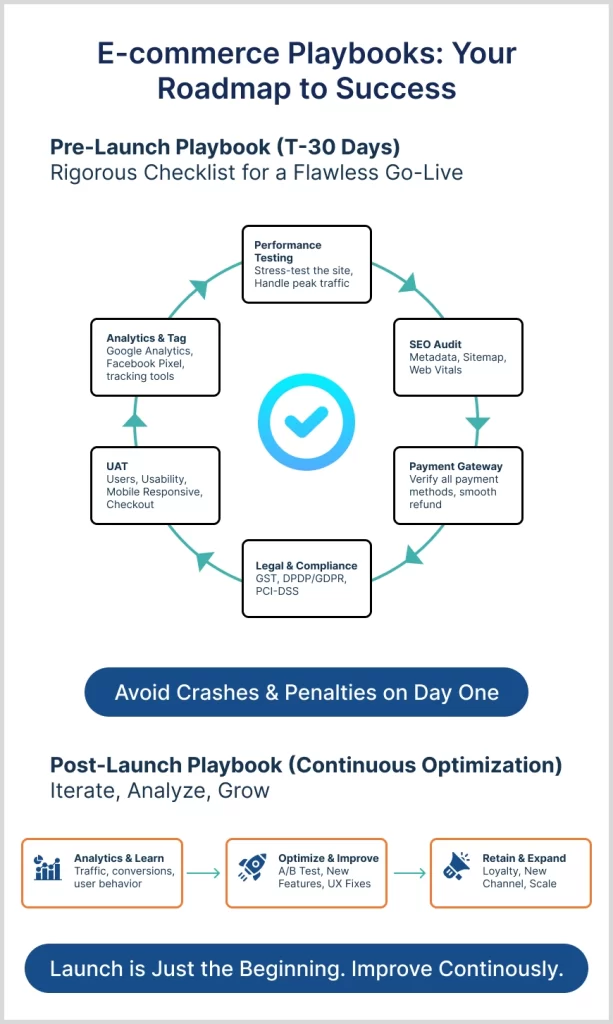
E-commerce projects often fail because they treat launch as the finish line. In reality, launch is just the beginning. A disciplined playbook approach ensures projects are tested, compliant, and optimized before launch — and continuously improved after.
Pre-Launch Playbook (T-30 Days)
Before going live, every e-commerce project should pass through a rigorous checklist:
- Performance Testing: Stress-test the site with simulated traffic to ensure it can handle campaigns and peak hours.
- SEO Audit: Check metadata, structured data, sitemap, and Core Web Vitals. Fix crawl issues before Google indexes errors.
- Payment Gateway Testing: Verify all payment methods (UPI, cards, wallets, COD) and ensure refunds process smoothly.
- Legal & Compliance Checks: Review GST invoicing, DPDP/GDPR compliance, PCI-DSS for payments, and consumer protection obligations.
- UAT (User Acceptance Testing): Have real users test the site for usability, mobile responsiveness, and checkout smoothness.
These steps ensure your site doesn’t crash or get penalized on day one.
Post-Launch Playbook (T+30/60/90 Days)
Once live, the focus shifts from setup to optimization and growth:
- T+30 Days: Monitor KPIs (conversion rate, cart abandonment, average order value). Fix any post-launch bugs. Launch initial ad campaigns and track ROI.
- T+60 Days: Begin CRO (Conversion Rate Optimization). Run A/B tests on product pages and checkout flows. Scale SEO content (blogs, guides, videos).
- T+90 Days: Expand payment/shipping options, launch loyalty programs, and introduce lifecycle marketing campaigns (welcome series, cart recovery, win-back flows).
Continuous Monitoring: Use analytics dashboards and heatmaps to track behavior. Monitor fulfillment SLAs and customer feedback. Feed learnings back into UX and operations.
Key Takeaway
A launch is successful not just because the website goes live but because it’s tested, compliant, and monitored continuously. The playbook approach ensures your project avoids the common post-launch pitfalls that sink many e-commerce stores.
Conclusion & Call-to-Action
E-commerce offers tremendous opportunities — but it also hides many traps. The high failure rate of online stores is not because customers don’t want to buy online, but because businesses often underestimate the complexity of building and sustaining a digital store.
As we’ve explored, the reasons for failure are predictable: weak strategy, poor user experience, outdated technology, chaotic catalog management, ignored SEO, checkout friction, lack of analytics, fragile operations, non-compliance, mismanaged projects, and neglected retention. The good news is that every one of these pitfalls is avoidable with the right planning and execution.
Successful e-commerce isn’t about copying Amazon or Flipkart. It’s about clearly defining your value proposition, validating demand, choosing the right technology stack, designing for mobile-first experiences, securing operations, and continuously optimizing after launch. It’s also about trust — giving customers confidence through transparency, reliability, and smooth service at every step.
At EzeOne Technologies, we’ve seen both sides of the story. We’ve studied why projects fail, and we’ve also built e-commerce platforms that succeed from day one — fast, secure, scalable, and trusted by customers. Our proven approach combines strategy, technology, SEO, and operations into a single roadmap that aligns with your business goals.
👉 If you’re planning to launch or scale your e-commerce store, don’t leave success to chance. Learn from the failures of others and apply best practices from the start.
📞 Contact EzeOne Technologies today for a free consultation. Let’s build you an online store that avoids failure and sets you up for long-term success in the fast-growing world of digital commerce.